Purpose & Strategic Importance
Strategic planning should build first on the data that already exists. Before collecting new information, National Societies should review the resources and evidence they already hold. This makes the process more efficient, credible, and focused. Looking at data over a period of time also allows long-term trends to be identified and understood.
Why this matters
- Ensures that new data collection is targeted rather than duplicating what already exists.
- Strengthens credibility by grounding the process in evidence.
- Saves resources and time that can instead be invested in consultation and analysis.
Enabling Resources
The role of the Coordination Team
It is usually the responsibility of the coordination team to pull together what data already exist — both from inside the National Society and from external sources. Their role is to:
- Compile and review existing information.
- Identify gaps where further consultation or research is needed.
- Ensure that data are presented in a clear way that can be shared back with leadership, branches, and stakeholders.
Inputs
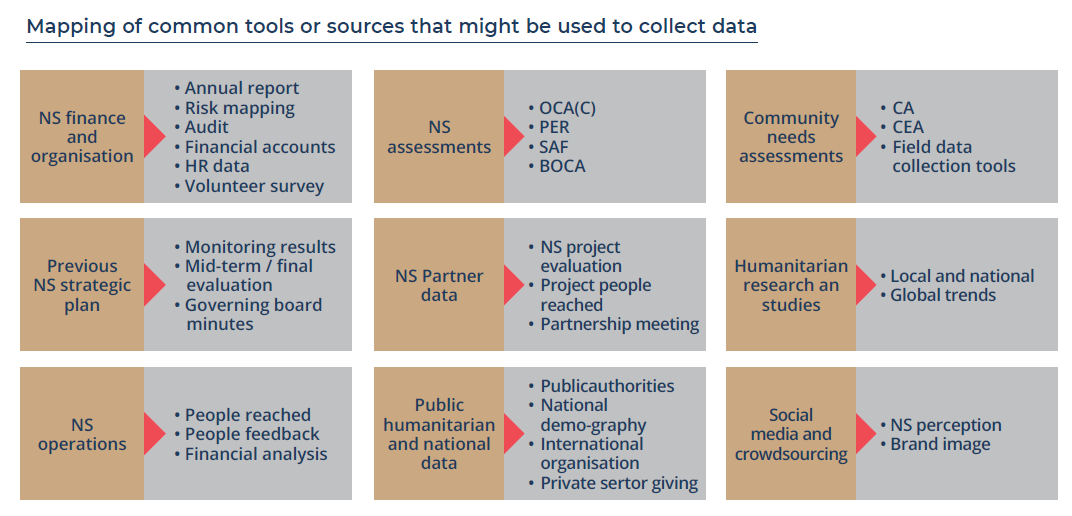
Common types of data a National Society may already hold
- Service and project figures – showing the number of people reached.
- Feedback and complaints data – satisfaction, feedback, and complaints collected from people served.
- Financial records – accounts from both branch and national levels.
- Volunteer and member data – numbers of volunteers, members, supporters, and hours volunteered.
- Volunteer surveys – data on happiness, motivation, and retention.
- Organisational and operational assessments – results from self-assessment tools, service or project evaluations, and follow-up actions.
- Monitoring of previous strategies – including mid-term or final evaluations of past plans.
- Governing Board and General Assembly minutes – highlighting strategic issues and challenges.
- Records of engagement with public authorities and partners – notes from meetings that show priorities and expectations.
Even if some sources are a few years old, they are often still useful and can provide relevant insights to inform today’s strategic planning.
Inputs
Additional background data sources
Strategic planning can also benefit from information gathered outside the Society:
- Reports from public authorities and international organisations (e.g. World Bank, WHO, UN agencies) on health, disasters, and demographics.
- Studies on trends in areas such as volunteerism or private sector giving.
- Insights from past events such as partnership workshops or strategic brainstorming.
- Government or sector-specific data (e.g. from Ministries or humanitarian forums).
These sources help place the National Society’s work in a broader national and global context.
Activities & Decisions
How much data is enough?
A key challenge for coordination teams is knowing how much data to collect.
- Too little risks decisions being made in the dark.
- Too much is costly, time-consuming, and may overwhelm the process.
Strategic planning is about the big picture, so the guiding question should be:
- Do the data give a “good enough” picture of the National Society to base long-term decisions on?
For every proposed data collection exercise, ask:
- What do we want to learn?
- What is the cost of collecting it (time, money)?
- What are the risks of not collecting it (missing insights, or leaving stakeholders feeling excluded)?
Examples & Learning
“As part of our strategic planning process, we reviewed key industry documents on health and humanitarian work. This helped us better align with the national authorities and improve our collaboration.” — Director of Programs, Central African Red Cross
This shows how existing information — both internal and external — can provide a strong starting point and strengthen the credibility of the strategy.