Value Proposition
Connect, welcome, orient, enable, and grow volunteers—and, where needed, attract, recruit, train, deploy, and retain them—so that communities receive safe, relevant, trusted, locally owned humanitarian action through sustainable local volunteer services and a strong, adaptable National Society volunteering system.
Purpose & Strategic Importance
Volunteers are the National Society’s main bridge to communities and one of its primary ways to act locally at scale. Strengthening this capability improves service quality, continuity, reach, trust, and the ability to mobilise humanitarian action in both everyday community life and times of crisis.
This capability is strategically important because National Societies need one coherent volunteering system that can work in different ways depending on context. Some forms of volunteering are rooted in local initiative, mutual aid, branch relationships, and volunteer-led community action, and need connection, guidance, and light but reliable support. Others require tighter structure, clear roles, stronger supervision, and readiness for risk-sensitive or specialist tasks. Volunteering is therefore not only a field-level resource but a strategic organisational choice: leadership must decide why and how volunteers are engaged, what place they hold in the organisation, and what resources will sustain them. Volunteering should complement paid work and widen humanitarian reach, participation, and community connection, not substitute for staff functions.
Strong National Societies are built from the community level upward. Sustainable local volunteer services create the platform from which the organisation can grow in scope, competence, relevance, and strength. When local volunteer service units are relevant, replicable, and sustained by community leadership and resources, they not only meet needs directly; they also attract wider support and strengthen branch and national structures. This capability therefore both enables volunteering to grow in ways that reflect local culture, programme needs, and branch reality, and protects volunteers and communities through proportionate duty of care. It helps avoid both under-supported volunteer action and over-bureaucratic systems.
Core Concepts & Definitions
- Volunteering spectrum: Volunteering in a National Society exists on a spectrum. Some roles are community-rooted, self-organised, and branch-led, while others are highly structured and require specialised skills. This matters because different contexts need different levels of structure, while still operating within one National Society system.
- Volunteer management and volunteer coordination: Volunteer management is the strategic work of creating the conditions, policies, roles, resources, and long-term direction that make volunteering sustainable and aligned with organisational goals. Volunteer coordination is the operational work of integrating, accompanying, and supporting volunteers in day-to-day practice. Distinguishing these two levels helps National Societies assign responsibilities clearly, invest appropriately, and avoid expecting branch coordinators or volunteer leaders to carry strategic functions without the required mandate or support.
- Volunteering framework: A practical organisational reference that translates policy into roles, processes, standards, participation mechanisms, and implementation responsibilities. It helps create continuity when people change, clarifies the place of volunteers in the organisation, and supports more consistent quality across branches and services.
- Volunteer programme: A coherent framework that defines what volunteers do, why the work matters, what profiles and skills are needed, what support is required, and how volunteer contributions are recognised and reviewed. Volunteer development should stay linked to programme and service design, not sit apart from it.
- Local volunteer service unit: A locally led Red Cross Red Crescent service rooted in a community, meeting a relevant local need, and able to mobilise local leadership, time, and resources to continue over time. Local volunteer service units provide the practical foundation from which a National Society can grow in reach, competence, and strength.
- Guided self-led volunteering: A form of volunteering in which volunteers and local branches take the lead in identifying needs, planning activities, mobilising modest local resources, and implementing action, while staying within the National Society’s mandate, principles, code of conduct, and simple coordination and approval structures. This allows strong local initiative without losing organisational coherence.
- Volunteer leaders: Experienced volunteers who not only recruit or mentor peers, but also organise volunteer groups, lead orientation, support peer wellbeing, and help keep local action aligned with community needs and Red Cross Red Crescent principles.
- Replicability: A model is replicable when it can be repeated in another geographical location with only minor local adaptation. In this capability, good volunteer and service models should be simple enough to spread across many communities without losing relevance or quality.
- Sustainability of local units: A local unit is sustainable when it can continue to deliver a simple relevant service using resources mobilised from within the community, even if external support becomes limited. Additional support from branches or partners should help the unit do more and do better, but should not be the sole condition for its survival.
- Duty of care and volunteer protection: The National Society’s responsibility to prevent and reduce harm to volunteers through safeguarding, safety, security, psychosocial support, risk management, incident reporting, and appropriate support measures such as insurance or reimbursement policies where relevant.
- Volunteer participation in decision-making: Volunteers are not only implementers. They should help shape the work they contribute to, especially at local level, so that programmes remain relevant, motivating, and grounded in community reality.
- Branch as facilitator: A branch is not only a delivery point. It can also be a local platform that listens, connects people, supports collective action, and channels volunteer energy in line with Red Cross Red Crescent principles.
- Proportionate management: The level of management, documentation, training, and supervision should match the role, risk, and context. Stronger controls are needed for higher-risk, specialist, or externally accountable roles; lighter support may be more appropriate for lower-risk, community-led action.
- Emergency volunteer pathways: In emergencies, a National Society may engage existing local volunteers, trained disaster management volunteers, and spontaneous volunteers. These groups may enter through different pathways and levels of structuring. Existing volunteers may act immediately based on prior orientation, while spontaneous volunteers usually pass through a compressed cycle with rapid assessment, shortened orientation, task-specific briefing, and closer supervision.
- New and flexible forms of volunteering: Volunteering is changing in form, duration, and motivation. National Societies need approaches that can accommodate digital volunteering, spontaneous volunteering, micro-volunteering, online campaigning, skilled and corporate volunteering, swarm volunteering, self-organizing volunteering, and combinations of these. This matters because the capability must support both lighter enabling pathways and more structured management pathways without losing coherence, safety, or accountability.
- Investment finance and maintenance finance: Investment finance covers the one-off or time-bound costs of creating new local units and the systems to support them. Maintenance finance covers the ongoing costs of keeping the wider support structure functioning after development ends. Distinguishing these helps National Societies grow without creating systems they cannot sustain.
Principles
- Humanity and relevance: We shape volunteering around humanitarian needs and priorities that communities themselves recognise as important.
- Voluntary service with dignity and complementarity: We treat volunteers as valued contributors and leaders, not only as unpaid labour, and ensure volunteering complements rather than substitutes paid work.
- Participation and ownership: We involve volunteers in shaping programmes, decisions, and improvements, especially where they know communities best.
- Protection and proportionality: We apply safeguarding, safety, security, wellbeing, and data protection measures in ways that are strong enough for the risk and simple enough for the context.
- Inclusion and diversification: We widen pathways into volunteering so that different people can contribute through different roles, time commitments, and forms of action.
- Coherence across the National Society: We allow local adaptation while maintaining one identity, one mandate, and one framework of standards, rights, and responsibilities.
- Learning, adaptation, and replication: We test, learn, document critical factors, and adapt models so successful local services and volunteer approaches can be replicated more widely at lower cost without losing relevance or quality.
- Value-based societies: We promote volunteering not only as service delivery, but as a way to strengthen tolerance, peace, mutual respect, solidarity, and care in society.
Activities
- Develop and evaluate volunteer policy
- Connect and Attract
- Welcome and Recruit
- Orient and Train
- Enable and Deploy
- Motivate and retain volunteers
Results
Outputs
Outcomes
Impact
Note: Each Output may link to examples and templates showing what good looks like and providing editable formats to get you started.
Metrics & Learning
- Enabling Resources (not consumed):
- % branches with a named volunteer coordinator, focal point, or equivalent volunteer leadership structure.
- % branches using a localised volunteering policy or minimum standards framework.
- % branches with a defined mechanism for volunteer participation in decisions and feedback.
- % branches with an emergency volunteer mobilisation plan covering existing volunteers, trained emergency volunteers, and spontaneous volunteers.
- % targeted communities with functioning local volunteer service units.
- % National Society statutes, rules, or regulations that clearly distinguish volunteers and members, including their roles and responsibilities.
- % branches or governance bodies with mechanisms for volunteer participation in decision-making.
- Inputs (consumed):
- Volunteer support budget spent vs planned, including orientation, safety, recognition, branch support, emergency volunteer welfare, and local service development.
- Staff and volunteer leader time invested in onboarding, coaching, supervision, emergency briefing, volunteer welfare, quality review, and service-model testing or replication.
- Small-grant, reimbursement, or local support funds used for volunteer-led initiatives, formal volunteer roles, and development of local service units.
- Processes:
- Median time from first contact to first participation, disaggregated by lighter enabling and more managed pathways.
- % volunteers receiving a structured contact interview before confirmation of role.
- % roles using a written volunteer agreement and signed code of conduct where required.
- % demanding roles using a time-limited trial period followed by review.
- % volunteers completing minimum orientation, code of conduct, and safety steps before action.
- % activities or roles assigned to an appropriate support model according to agreed decision rules.
- Average cost of establishing a new local volunteer service unit.
- Time from initial model design to replication in additional communities.
- % emergency volunteers receiving task briefing before deployment.
- Time to mobilise trained emergency volunteers after activation.
- % accepted spontaneous volunteers processed through registration, screening, orientation, and assignment procedures.
- % emergency operations monitoring shift length, rest periods, and supervisor coverage.
- Outputs:
- # active volunteers in defined roles and # active volunteers in volunteer-led local initiatives.
- % volunteers with up-to-date records for role, learning, participation, contact details, and emergency availability where relevant.
- # branches with active volunteer-led initiatives, peer learning, or local volunteer groups.
- # documented local service models tested and approved for wider replication.
- # emergency operations using public messaging on volunteer needs and spontaneous-volunteer procedures.
- % volunteer contributions captured across service, administrative, governance, and specialized volunteering roles.
- % volunteers covered by a volunteer insurance mechanism where required by policy.
- Outcomes:
- Volunteer satisfaction with simplicity of first contact, reliability of accompaniment, recognition, flexibility, and information flow.
- Volunteer satisfaction with participation opportunities, transparency, training opportunities, and conflict handling.
- Volunteer satisfaction, sense of belonging, and sense of agency.
- 12-month retention rate and top reasons for staying or leaving.
- Community feedback on the relevance, trustworthiness, and inclusiveness of volunteer action.
- % emergency volunteers receiving debriefing and, where needed, referral to psychosocial or professional support.
- # dormant or inactive branches reactivated through volunteer-led or self-led approaches.
- # communities where volunteer-led initiatives are the main or only active branch service.
- Amount of locally raised financial or in-kind support mobilised by volunteer groups or branches.
- # peer-learning or branch-to-branch exchange activities completed per year.
- % volunteer groups led by trained volunteer leaders.
- % volunteers participating in peer-support groups or structured wellbeing support where relevant.
- Improvement in volunteer engagement, motivation, and wellbeing as measured by motivational or experience tools over time.
- % volunteer representation reflective of the diversity of the country’s population.
- Impact:
- # priority communities reached through volunteer-supported services and local initiatives.
- Continuity of local action during funding gaps, local shocks, or emergencies.
- % local volunteer service units still active after a defined period without project funding.
- % local volunteer service units mobilising local leadership and locally sourced human, financial, or in-kind support.
- Growth in community trust, local participation, and locally mobilised support around branch action.
- Evidence that volunteer units and branch capability are stronger after major emergency operations than before.
- Learning & Adaptation (cross-cutting):
- # improvements made after volunteer feedback, community feedback, incidents, complaints, exit interviews, or after-action review.
- % branches reviewing whether they are over-managing or under-supporting volunteering.
- % branches using retention, welfare, incident, participation, or replication data to improve practice.
- % branches conducting volunteer satisfaction reviews or surveys every 2–3 years.
- % departing volunteers completing an exit conversation and receiving recognition or a record of contribution where appropriate.
- % emergency operations reviewed for volunteer effectiveness, supervision quality, spontaneous-volunteer handling, welfare support, and transition back to normal services.
- Documented critical factors, failures, assumptions, costs, and adaptations from service-unit testing and replication.
- # initiatives co-developed with sister National Societies or cross-border volunteer networks.
- # new initiatives developed with volunteers’ participation.
- % branches or National Societies reporting volunteering data through a homogeneous system and, where relevant, to IFRC reporting mechanisms.
Learning questions:
- How and why does volunteering grow more strongly in some branches than others, and what role do relevance, social dynamics, local leadership, programme design, onboarding quality, and emergency experience play?
- Under what conditions does a lighter enabling approach produce stronger participation and sustainability than a more managed approach?
- Which local service models prove most replicable across communities, and what factors most influence success, cost, or failure during replication?
- What adaptations to volunteer welfare, recognition, supervision, participation, exit management, or support-structure design most improve retention and motivation?
- Do emergency operations and local service expansion leave volunteer units and branch systems stronger, weaker, or unchanged, and why?
Enabling Resources
- People:
- Roles:
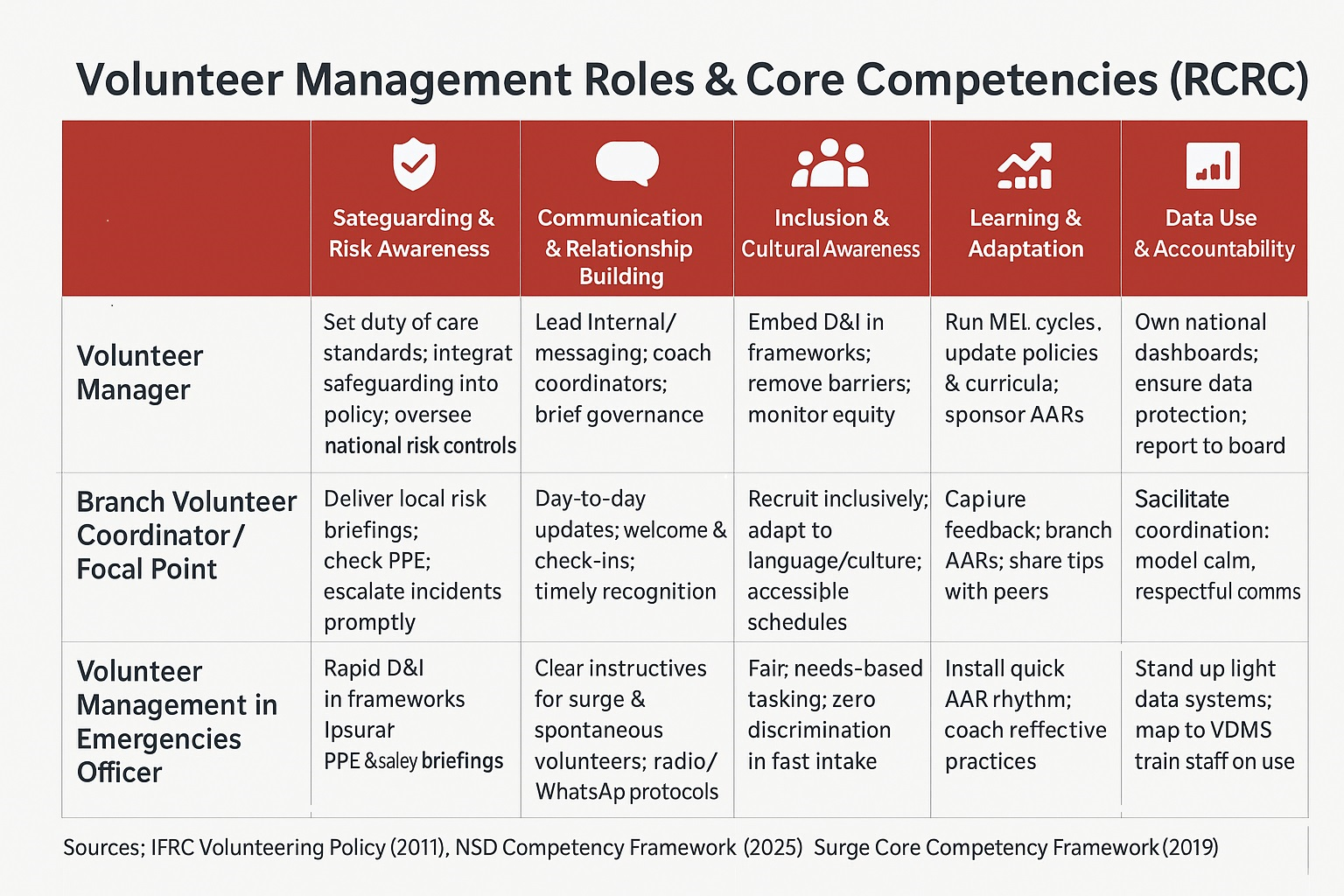
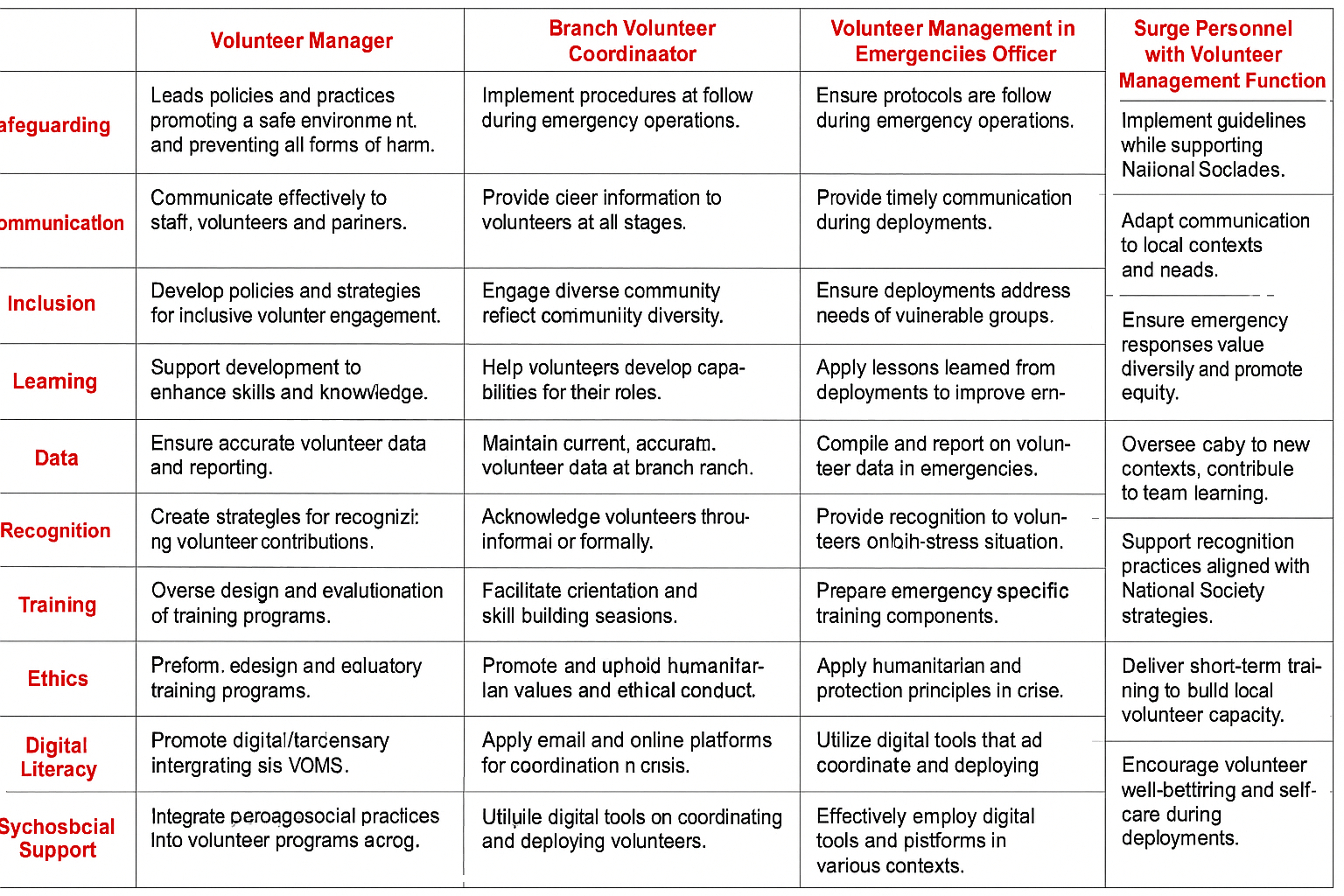
- National Volunteering Lead / Coordinator: Provides overall direction for volunteering development, policy localisation, branch support, and cross-organisational coordination so volunteering is coherent across programmes and levels.
- Competencies: Strategic leadership, policy interpretation, change management, branch support, volunteer development, and risk judgement.
- DTR / Service Development Team: A small focused team, especially in early phases, that can design, test, document, and refine local volunteer service models, train others, support replication, and help align support structures as the model grows.
- Competencies: Community facilitation, documentation, adaptive learning, quality assurance, training, and local credibility through local knowledge or connections.
- Branch Volunteer Coordinator / Focal Point: Anchors volunteer engagement locally, supports the paired process steps, and helps connect volunteer groups, programmes, staff, and communities.
- Competencies: Relationship-building, coaching, inclusion, basic administration, communication, and local problem-solving.
- Programme Coordinators and Operational Leads: Define how volunteers contribute to specific programmes and operations and ensure role clarity, support, and coordination with volunteering structures.
- Competencies: Programme design, role definition, supervision, cross-team collaboration, and community-facing planning.
- Volunteer Leaders and Peer Recruiters: Welcome new volunteers, support peer learning, model values and behaviour, and help sustain local groups and initiatives.
- Competencies: Facilitation, mentoring, trust-building, communication, practical leadership, volunteer-group organisation, peer-support facilitation, orientation delivery, and the ability to align local initiative with community needs and Red Cross Red Crescent principles.
- Supervisors for role-critical or emergency functions: Oversee volunteers in specialist, emergency, or higher-risk assignments and ensure safe and effective task performance.
- Competencies: Technical competence, supervision, incident management, volunteer protection, psychosocial awareness, and operational coordination.
- National Volunteering Lead / Coordinator: Provides overall direction for volunteering development, policy localisation, branch support, and cross-organisational coordination so volunteering is coherent across programmes and levels.
- Culture: A culture that values volunteers as contributors, leaders, and partners in humanitarian action; supports autonomy where appropriate; respects local initiative and local culture; supports constructive volunteer-paid staff relationships; treats recognition, information flow, and feedback as part of good accompaniment; addresses conflict early through dialogue and fair procedures; keeps focus on community-level services as the foundation of the wider organisation; and promotes learning for and from volunteers through coaching, mentoring, and peer exchange.
- Mentors: Experienced branch leaders, volunteer leaders, peer networks, and reference practitioners who can coach branches on both structured volunteer management and volunteer-led local action, including development of sustainable local service units.
- Roles:
- Governance:
- Localised volunteering policy aligned with Movement principles and national law.
- Alignment with national volunteering legislation and engagement with public authorities, where appropriate, to promote laws and regulations that create an enabling environment for volunteering.
- A practical volunteering framework or concept that translates policy into roles, processes, standards, participation mechanisms, quality expectations, and implementation responsibilities.
- Clear written guidance on volunteer rights, responsibilities, code of conduct, confidentiality, use of the emblem, participation, reimbursement, complaints handling, and the distinction between volunteering and paid employment.
- Clear distinction in statutes, rules, or regulations between volunteers and members, including their roles and responsibilities.
- Written volunteer agreements that clarify tasks, responsibilities, rights, duties, and limits, and that protect both the volunteer and the organisation through clear mutual expectations.
- Code of conduct procedures that include discussion of the code with the volunteer, not only signature, so that problematic behaviour is actively prevented rather than addressed only after harm occurs.
- Role-appropriate safeguarding and suitability checks, including additional checks where volunteers work directly with children or other particularly vulnerable people, in line with national law and policy.
- Minimum standards for safeguarding, safety, security, psychosocial support, incident reporting, and volunteer wellbeing across all forms of volunteering.
- Emergency volunteer policies covering mobilisation of existing volunteers, spontaneous volunteers, volunteers affected by the emergency, volunteer hours, reimbursement, and the point at which volunteers should be employed under labour law.
- Delegated authority and escalation pathways that help branches decide when lighter enabling support is enough and when tighter management is required.
- Governance arrangements that support volunteer participation in policy development, local decision-making, service improvement, and feedback, with clear levels of participation ranging from information and consultation to co-decision and volunteer autonomy where appropriate.
- Governance arrangements that give volunteers opportunities to contribute not only to programme design and service improvement, but also to boards, governance committees, and membership structures where appropriate.
- Structured channels for volunteers to raise ideas, suggestions, concerns, and complaints, and for the organisation to respond visibly and consistently.
- Leadership and governance alignment on community-based growth, including a shared vision for how local volunteer service units, branch support structures, and national systems should evolve together over time.
- Simple approval and oversight arrangements for self-led branch activities, including light budget review and mandate checks that allow initiative while preventing misalignment or misuse of funds.
- Legal risk management and insurance arrangements that cover accepted volunteers involved in emergency operations.
- Data:
- Volunteer profiles covering skills, interests, availability, location, and participation history.
- Training, certification, supervision, activity, and emergency contact records for more managed roles.
- Simple branch-level data on local volunteer groups, volunteer-led initiatives, feedback, welfare, retention, and local service-unit coverage.
- Systems to capture, process, and follow up spontaneous volunteers where they may be accepted.
- Incident, safeguarding, fatigue, wellbeing, satisfaction, exit, replication, and local-resource-mobilisation data used to improve support and reduce harm.
- Volunteer data systems that support onboarding, engagement, accreditation, insurance, and evidence-based management across the full volunteer experience.
- Harmonized data standards and reporting arrangements that allow accurate internal analysis and, where relevant, reporting to the IFRC on volunteering.
- Simple, flexible, and agile data practices that balance volunteer-oriented approaches with sufficient standardization across the National Society.
- Tools & Technology:
- Volunteer data and communication systems that support registration, records, learning, messaging, scheduling, and reporting.
- Branch-friendly templates for volunteer programmes, role profiles, interview guides, trial periods, volunteer agreements, codes of conduct, orientation, small initiative support, feedback collection, complaint handling, recognition, exit conversations, and local service model documentation.
- Simple enabling tools such as activity catalogues, project proposal templates, and basic budget forms that help volunteers turn ideas into mandate-aligned local action without heavy bureaucracy.
- Public communications tools and pre-agreed messages that can quickly state whether volunteers are needed, what skills are sought, and how potential volunteers should respond.
- Systems to assess, register, orient, and assign spontaneous volunteers, including a physical or virtual volunteer centre where relevant.
- Simple communication tools and routines that keep volunteers informed, connected, and able to contribute ideas and concerns throughout the engagement.
- Learning tools for induction, emergency volunteering, psychosocial support, peer exchange, quality review, model documentation, and simulation exercises.
- Facilities & Equipment:
- Accessible branch spaces for meetings, orientation, peer learning, and volunteer support.
- Training venues, basic ICT, and communication equipment.
- Protective equipment, visibility items, and practical materials proportionate to the volunteer role or activity.
- Provision for food, water, rest, accommodation where needed, and safe operating conditions during emergency deployments.
- Financing Mechanisms:
- Core internal or partner support for volunteer systems, training, safety, communication, and recognition.
- Small-scale, branch-friendly funding or in-kind support for volunteer-led initiatives.
- Reimbursement arrangements that prevent volunteers from being financially disadvantaged by participation, in line with approved policy.
- Investment finance for the one-off or time-bound costs of creating new local units and building the systems to support them, including project teams, travel, training, testing, and replication.
- Maintenance finance for the ongoing costs of intermediary and national support structures once development ends, including staffing, travel, coordination, and quality assurance.
- Funding for volunteer insurance, emergency equipment, sustenance, record-keeping, psychosocial support, quality reviews, and materials needed to engage spontaneous volunteers when relevant.
- Local fundraising and partnership pathways that help sustain volunteer action beyond project cycles.
- Support for modest local fundraising by branches and volunteer groups, including simple budgeting, review, and approval processes that allow local initiative while maintaining financial control and accountability.
- Long-term revenue streams for higher-level support structures that are less likely to be self-financing than community-level units.
- Guidance & Learning Resources:
- Volunteering development frameworks, volunteer management cycle guidance, DTR guidance, emergency volunteering guidance, and the IFRC Volunteering Policy.
- Volunteer policy guidance, legal guidance, and branch SOPs for volunteer rights, responsibilities, protection, and data handling.
- Psychosocial support, recognition, inclusion, volunteer participation, and complaint-handling resources.
- Scenario-based tools, simulations, satisfaction survey tools, local service model documentation tools, and after-action learning materials that help branches practise emergency mobilisation and improve future operations.
- Case studies and peer-learning materials that show how to adapt volunteering systems to different branch realities, emergency phases, programme needs, and stages of replication.
Examples & Innovative Practices
How the Burundi Red Cross built a community of 600,000 volunteers
In 2007, the Burundi Red Cross created decentralized support groups called ‘Unités Collinaires’. Each ‘Unité Collinaire’ is made up of volunteers who have gradually come together to support vulnerable people in their community.
The Spanish Red Cross app, connecting the volunteers of the association
The Red Cross App is a technological tool that aims to mobilise society against vulnerability. On its app, the Spanish Red Cross proposes several humanitarian missions anyone can participate in. It is useful to encourage people to commit and to increase the organisation’s means.
Children’s vision, empowering the youth to become agents of change
Children’s Vision is a program that was developed by the Youth sector volunteers, within the Lebanese Red Cross. Targeting one of the main needs in its community: overcoming difficulties as teenagers (such as social withdrawal, extreme stress, alcohol abuse, substance use, bullying, etc). Offering a Youth-Friendly space, through which they can develop their skills and acquire new information.
Help Red Cross, supporting new volunteers during the pandemic crisis in Georgia
Help Red Cross is an online digital platform which aims to invite, train, and mobilise the volunteers to join the Covid-19 Response Team.
Digital volunteering, the response of Singapore to global disasters
Singapore Red Cross launched a Disaster Surveillance Team (DST) to monitor global natural or man-made incidents that may call upon the need of international humanitarian assistance.
How the Iraqi Red Crescent involved the community and its volunteers in the strategic planning
Community participation is targeted by the Iraqi Red Crescent’s (IRC) activities in their programs and services, including their strategic planning.
Empowering volunteers through digital data management
A digital data management approach to better support, coordinate, and empower volunteers through improved information and follow-up.
How the Burundi Red Cross is building the capacity of its volunteers
The Burundi Red Cross strengthened volunteer capacity through structured training and local-level organization to improve service quality and sustainability.
The pool of 10,000 one-off volunteers at the Danish Red Cross
The Danish Red Cross created a large pool of “one-off” volunteers to enable flexible, short-term engagement and rapid mobilisation when needed.
Volunteers in every street, the power of Whatsapp during the pandemic
Using WhatsApp to coordinate, communicate, and mobilise volunteers quickly during the pandemic response, enabling street-level coverage and fast community support.
The Interamerican Centre for Volunteering Development
In the Americas Region, the Interamerican Centre for Volunteering Development (ICVD) was established by IFRC’s Volunteering & Youth Development Unit to support National Societies through a platform of tools, exchanges, and knowledge for volunteering development and management. volunteeringredcross.org
Variations in Practice
In higher-risk emergency, health, logistics, or specialist roles, the more managed expression of this capability will usually be stronger, with clearer role profiles, formal onboarding, competency checks, supervision, and deployment control. In branch-rooted local service, youth engagement, community development, and lower-risk mutual aid, the lighter enabling expression may be stronger, with more emphasis on listening, peer pathways, volunteer participation, local initiative, development of simple sustainable services, and more agile participation through new and flexible forms of volunteering.
In emergencies, the two expressions may appear sequentially as well as simultaneously. An initial response may be provided by existing local volunteers rooted in the affected community, followed by trained disaster management volunteers organised at regional or national level, and then, where appropriate, spontaneous volunteers accepted into more structured roles through a compressed cycle of screening, orientation, briefing, and supervision.
In larger National Societies, digital systems, dedicated volunteer teams, service-development teams, and specialised programme coordinators may support a more differentiated system. In smaller or resource-constrained settings, branches may rely more on volunteer leaders, simple tools, local relationships, and progressive replication of one or two service models. Good practice is not choosing one model only, but applying both appropriately within one coherent volunteering system and building outward from sustainable local services.
Common Challenges and Risks
- Applying one model to all volunteering: Treating all volunteering as if it required the same level of formality can either over-bureaucratise local action or leave higher-risk roles under-managed. Mitigation: Use simple decision rules to match the support model to the role, risk, and context.
- Weak programme relevance: Volunteers are harder to engage and retain when roles are not linked to needs that communities and volunteers see as meaningful. Mitigation: Define volunteer programmes and opportunities around real humanitarian priorities and local feedback.
- Volunteers used as substitutes for paid staff: Volunteering can lose legitimacy and become exploitative if it is used to fill structural staffing gaps without clear boundaries, support, and role design. Mitigation: Define the purpose and limits of volunteer roles strategically, ensure volunteering complements rather than replaces paid work, and review role design when workloads or expectations shift.
- Non-sustainable local models: Local volunteer services may show early promise but fail to scale if they depend too heavily on external support or cannot mobilise local leadership and resources. Mitigation: test sustainability early, simplify the model, and prioritise approaches that can continue at community level with modest support.
- Volunteer initiative drifting away from mandate or community need: Highly motivated volunteers, especially youth, may propose activities that do not match community priorities or exceed the National Society’s mandate. Mitigation: use orientation, activity catalogues, volunteer-leader coaching, simple proposal review, and ongoing branch or HQ guidance to align initiative with principles and real needs.
- Poor volunteer-paid staff relationships: Confusion, mistrust, or weak coordination between staff and volunteers can reduce motivation and service quality. Mitigation: Clarify roles, responsibilities, communication channels, and shared expectations in induction and supervision.
- Volunteer financial disadvantage or per diem dependence: Volunteering can become exclusionary or unsustainable if people are expected to absorb costs or if participation becomes tied only to funded incentives. Mitigation: Apply clear reimbursement policies, distinguish clearly between volunteering and paid employment, and use employment contracts where work patterns require them.
- Weak protection and welfare systems: Volunteers may face harm, burnout, or exclusion if safeguarding, safety, psychosocial support, fatigue monitoring, and incident handling are weak. Mitigation: Apply minimum standards across all volunteering pathways, monitor working time and rest, and review support systems after incidents and high-stress operations.
- Overload of volunteer leaders in low-resource settings: Strong self-led models can place heavy demands on a small number of experienced volunteers. Mitigation: build peer-support groups, monitor overwork, provide psychosocial support, and develop a wider pool of trained volunteer leaders over time.
- Poorly managed spontaneous volunteers: Unscreened or poorly briefed spontaneous volunteers can create protection, reputational, legal, and operational risks. Mitigation: Decide in advance whether and when spontaneous volunteers will be accepted, communicate clearly, and use defined registration, orientation, and supervision procedures.
- Exclusion through informal networks: Peer and family recruitment is effective but can exclude people who are less connected. Mitigation: combine social recruitment with intentional outreach and inclusion measures.
- Low recognition and voice: Volunteers may leave when they do not feel recognised, listened to, or involved in decisions. Mitigation: make recognition continuous, create volunteer feedback loops, include volunteers in planning and review, and provide meaningful closure when they leave.
- Emergency growth that weakens long-term capacity: Large operations can damage the National Society if they create poor volunteer experiences, blur the line between volunteer work and temporary labour, or build activities that cannot be sustained after funding ends. Mitigation: plan from the start for supervision quality, sustainable roles, volunteer transition, and post-operation learning.
Implementation Notes
- Start with a strategic decision on why and how the National Society wants to engage volunteers, then translate that decision into a practical volunteering framework, role definitions, onboarding tools, participation mechanisms, quality standards, and local service models that branches can actually use.
- Start by agreeing that this is one capability with two valid expressions: a lighter enabling expression and a more managed expression.
- Define volunteer programmes and profiles before redesigning process steps, so the system stays linked to actual services, operations, community needs, and sustainable local service models.
- Use the paired process language consistently: Connect / Attract, Welcome / Recruit, Orient / Train, Enable / Deploy, and Grow / Retain.
- Keep common minimum standards across both expressions for principles, rights and responsibilities, safeguarding, safety, data protection, and volunteer welfare.
- Sequence early investment where conditions for success are strongest, then use visible success, documented learning, and progressive adaptation to expand into more challenging areas over time.
- Document critical factors, failures, assumptions, costs, and adaptations systematically from the start, so that replication becomes more efficient, more reliable, and less dependent on individual experience.
- Build emergency contingency plans that clarify how existing volunteers, trained emergency volunteers, and spontaneous volunteers will be mobilised, supported, communicated with, and, where relevant, declined.
- Invest early in branch coordinators, volunteer leaders, programme-level collaboration, service-development teams, and trained supervisors, because local implementation depends as much on relationships and coaching as on policy.
- Build in volunteer participation from the start when reviewing policy, designing programmes, refining service models, and improving branch practice.
- Use simple, useful data that helps branches act and learn, rather than collecting information that only serves reporting upwards.
- Use simple enabling tools—such as activity catalogues, proposal templates, basic budgets, peer exchange, and volunteer-leader development—to support local initiative without reproducing heavy project bureaucracy.
- Work not only within national law, but also with public authorities where appropriate to improve the legal and policy environment for volunteering.
- Ensure volunteer participation extends beyond programme delivery into governance, membership, and organisational development where appropriate.
- Monitor volunteer motivation and wellbeing regularly and act on the findings, rather than treating motivation as an indirect by-product of good management.
- Build more agile pathways for new and flexible forms of volunteering, while keeping minimum standards for safety, inclusion, data protection, and accountability.
- Use peer-to-peer exchange, collaboration with sister National Societies, and partnerships with other organizations and the private sector to widen innovation and reach.
- Test the revised model in simulations as well as real operations, including one branch-led community setting and one higher-control emergency setting, then refine guidance before wider rollout.
- Include post-operation debrief, psychosocial follow-up, and supported return to normal services as standard parts of emergency volunteer management.
- Plan for exit as well as entry, so that volunteers leave with dignity, knowledge is not lost, and future engagement remains possible.
- As the community base grows, adapt intermediary and national structures deliberately so that support systems, leadership attention, and organisational culture remain aligned with community-level services as the foundation of the National Society.