Gestionar y Desarrollar Voluntarios

Por admin ,
html

La Política de Voluntariado de la IFRC destaca la importancia tanto de la gestión de voluntarios como del desarrollo del voluntariado, dos procesos interrelacionados que son esenciales para fomentar una base de voluntarios comprometida y efectiva.

  • Gestión de Voluntarios se refiere a los procesos estructurados que apoyan a los voluntarios durante todo su recorrido, incluyendo la atracción, el reclutamiento, la capacitación, el compromiso y el reconocimiento. Garantiza que los voluntarios tengan los recursos, habilidades y apoyo necesarios para contribuir de manera significativa y segura.
  • Desarrollo del Voluntariado se centra en fortalecer el ecosistema general del voluntariado. Incluye la creación de políticas, fomentar un entorno propicio, innovar nuevas formas de compromiso y garantizar que el voluntariado sea valorado y promovido como una fuerza para el cambio social.

Ambos van de la mano: una gestión eficaz de voluntarios asegura que los voluntarios individuales prosperen en sus roles, mientras que el desarrollo del voluntariado garantiza que las condiciones para el voluntariado en sí mismo permanezcan fuertes, relevantes e impactantes en un mundo cambiante.

El proceso de gestión y desarrollo de voluntarios es un marco integral que incluye:

  1. Desarrollar y Evaluar la Política de Voluntariado: Establecer pautas claras que describan los roles, responsabilidades y expectativas de los voluntarios. La evaluación regular asegura que estas políticas sigan siendo relevantes y efectivas.
  2. Atraer: Crear una marca atractiva y una estrategia de mensajes para atraer a potenciales voluntarios. Esto puede incluir la difusión a través de redes sociales, eventos comunitarios y asociaciones para promover la organización y su misión.
  3. Reclutar: Seleccionar voluntarios cuyas habilidades, valores y metas se alineen con las necesidades de la organización, lo cual típicamente implica entrevistas, revisiones de aplicaciones y a veces verificaciones de antecedentes.
  4. Capacitar: Proporcionar una orientación estructurada y capacitación específica en habilidades para preparar a los voluntarios de manera efectiva para sus roles y responsabilidades dentro de la organización.
  5. Desplegar: Asignar a los voluntarios roles que coincidan con sus habilidades y preferencias, asegurando que tengan los recursos y apoyo necesarios para desempeñarse bien.
  6. Optimizar la Experiencia del Voluntario: Fomentar un ambiente positivo comprometiendo, reconociendo y apoyando a los voluntarios, alentando retroalimentación y mejorando continuamente la experiencia del voluntariado para retención y satisfacción.

Este proceso no solo construye un equipo de voluntarios dedicado sino que también mejora la capacidad de la organización para lograr su misión de manera efectiva.
Submitted on

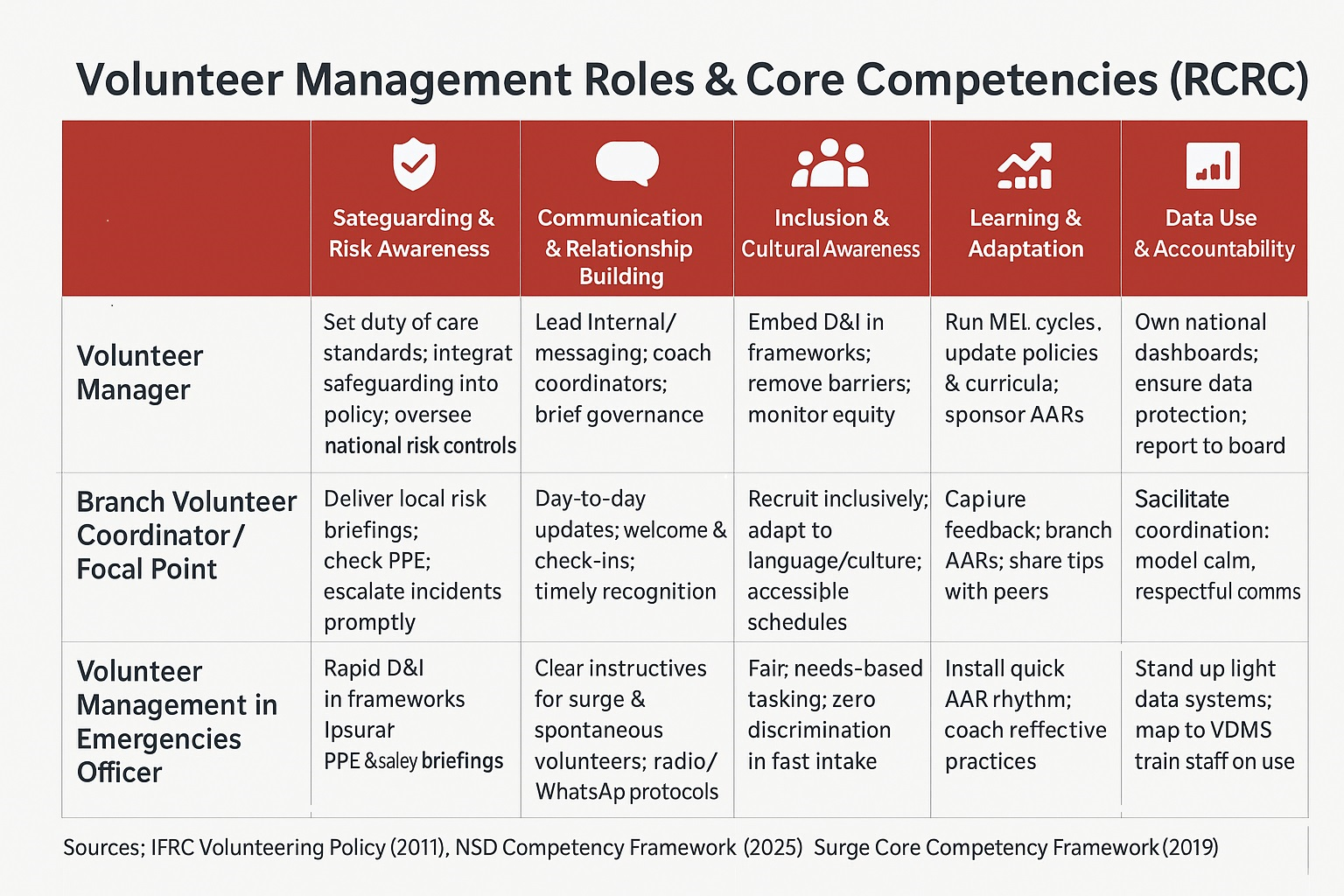
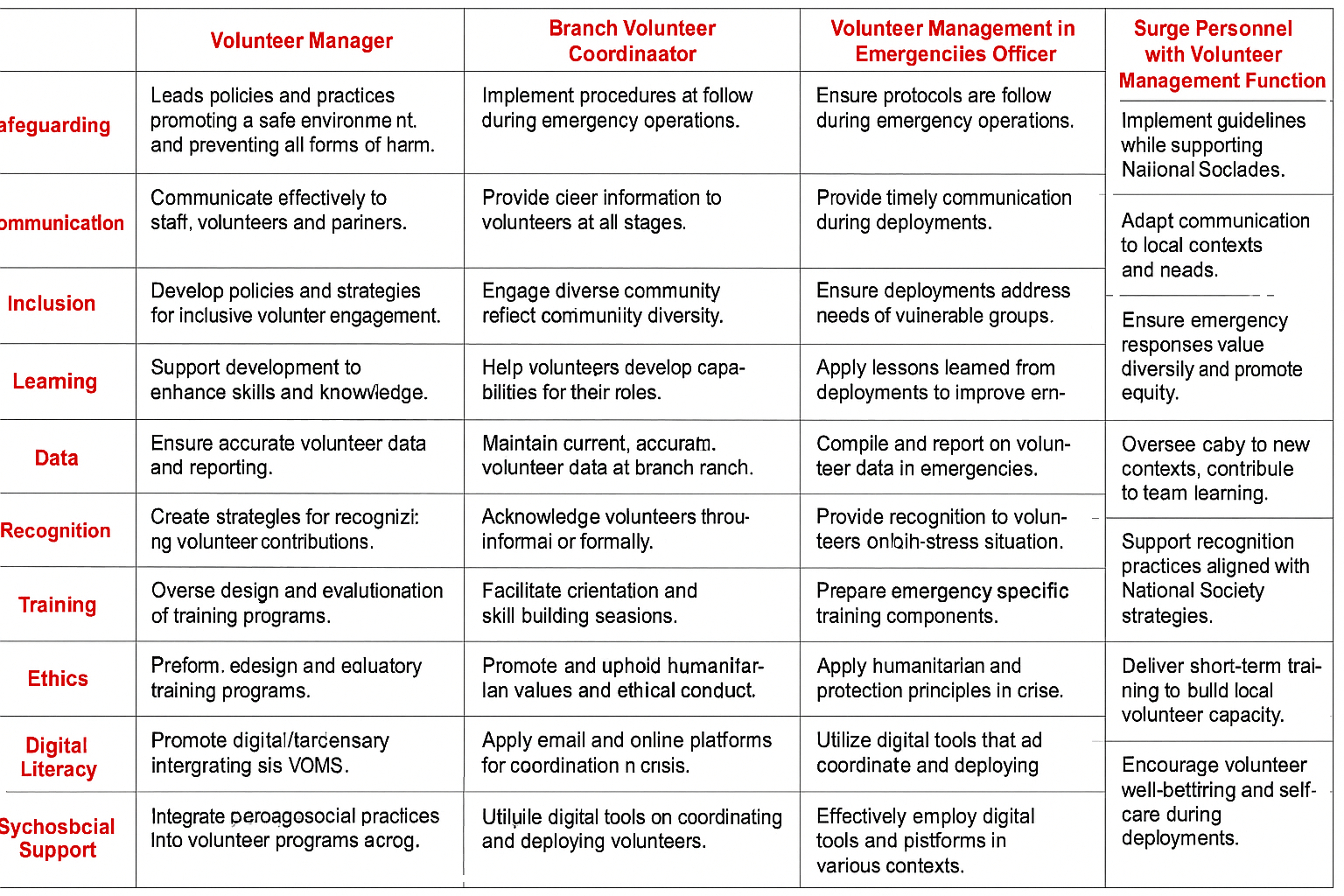
Volunteer management is not just about processes—it’s about people. Different roles carry different responsibilities, and each requires a set of core competencies to be performed well. By defining these roles clearly and supporting them with the right skills, National Societies can ensure that volunteers are safe, motivated, and well-led. The framework below maps out the key roles involved in volunteer management and the competencies they must master. It draws on the IFRC Volunteering Policy, the NSD Competency Framework, and the Surge Core Competency Framework, as well as lessons from National Societies.
IFRC Volunteering Policy (2011)
NSD Competency Framework (2025)
Core Competency Framework for Surge Personnel (2019)
Competency Development Guide (Surge Learning) 

Role–Competency Matrix

This framework maps the core competencies required across key roles in volunteer management. It shows how each competency is applied differently depending on the role, providing clarity for training and development in National Societies.

Why this matters

  • Clarity reduces risk: Everyone knows who is responsible for what, reducing duplication and gaps.
  • Competencies drive confidence: Staff and volunteers in leadership roles feel equipped to manage situations fairly and safely.
  • Learning is continuous: Competencies are not fixed—they grow through training, mentoring, and reflection, which this framework encourages.

The roles and competencies outlined here are not theoretical—they are grounded in the real practices of National Societies around the world. Every Volunteer Manager, Branch Coordinator, or surge role holder benefits from clear expectations and a roadmap for development. National Societies can adapt this matrix to their context, add local role profiles, and connect competencies to their training systems. By doing so, they create a workforce of leaders who protect, inspire, and sustain volunteerism at every level.

Competencies:

Safeguarding & Risk Awareness
Communication & Relationship Building
Inclusion & Cultural Awareness
Learning & Adaptation
Data Use & Accountability
Volunteer Recognition & Motivation
Training & Capacity Building
Ethical & Legal Awareness
Digital Literacy & Technology Use
Emotional Intelligence & Psychosocial Support (PSS)
 

Submitted on

Surge Personnel are deployed rapidly to support National Societies during crises. Those with volunteer management functions bring in technical expertise to strengthen systems, mentor local staff, and set up processes for safe engagement of volunteers. Their role is short-term but catalytic, leaving behind stronger capacity.

Key aspects

  • Provides technical support on registration, training, recognition, and data management in emergencies.
  • Coaches local managers and coordinators to sustain improvements after the surge mission ends.
  • Integrates global standards (e.g., Surge Core Competency Framework) into local practice.

Surge personnel help bridge the gap between immediate crisis needs and long-term volunteer development. Their role is to strengthen—not replace—local structures, so that volunteer engagement continues to thrive once the emergency has passed.

Submitted on

Emergencies bring unique challenges: large numbers of spontaneous volunteers, high-risk environments, and urgent deployment needs. A Volunteer Management in Emergencies Officer is responsible for ensuring volunteers are integrated safely, efficiently, and in line with humanitarian principles during crisis response.

Key aspects

  • Sets up rapid registration, briefing, and deployment systems for spontaneous and affiliated volunteers.
  • Ensures minimum standards of safety, psychosocial support, and duty of care are upheld in emergencies.
  • Coordinates with operations managers to match volunteers to urgent tasks without compromising well-being.

Without strong volunteer management in emergencies, volunteers can be left unprotected, or worse, put at risk. This role ensures volunteers are safe, useful, and respected, while maximising their contribution to humanitarian response.

Submitted on

Good governance is the safety net for volunteers and communities. It translates Movement principles into everyday protection, inclusion, and accountability. This page brings together the IFRC Volunteering Policy, the Volunteerism & Legislation Guidance Note, and the Legal Issues Toolkit, and shows how to localise them into clear, branch-friendly procedures. Governance is practical: agreeing what rights and responsibilities volunteers have, how complaints are handled, what insurance and duty of care look like, and how decisions are recorded and reviewed. When these foundations are in place, the rest of the volunteer lifecycle becomes fairer, faster, and safer. 
IFRC 
Volunteering & Legislation
Legal Issues related to Volunteering 
 

  • Policy first: Localise the IFRC Volunteering Policy and use it in induction, supervision, recognition, and exit. IFRC Volunteering Policy
  • Law in plain language: Use the joint Guidance Note and the Legal Toolkit to create simple checklists for screening, insurance, data protection, and incident handling.
  • Standards for safety & well-being: Adopt the IFRC standards that set minimums for keeping volunteers safe, secure, and well, and link them to branch SOPs. IFRC Implementation Guide

Treat governance documents as living tools. Test them with volunteers and coordinators to ensure they’re understandable and humane. After any incident, debrief and adjust the relevant clause or SOP—then brief branches on what changed and why. Regular reviews (every 3–5 years, or sooner when laws change) help keep practice aligned with principles and context. 

Submitted on

Voluntary service is a fundamental principle of the International Red Cross and Red Crescent Movement. Our Strategy 2030 emphasizes volunteering as one of the key transformations required to respond to future challenges.

The purpose of this policy is to set our collective commitment to volunteering within the IFRC network, as it applies to all National Societies and the IFRC Secretariat.

image
IFRC Volunteering Policy
Submitted on

Data is how we listen at scale. When used ethically, it helps us understand who our volunteers are, what support they need, and how our choices affect their experience. This page outlines minimum data sets for each lifecycle stage—profile, training, activity, recognition, feedback, safety, and exit/retention—so teams can focus on a few meaningful indicators rather than collecting everything and using nothing. It also points to secure systems and dashboards, including the IFRC’s Volunteer Data Management System (VDMS), which has been co-developed and implemented with National Societies. The aim is simple: collect only what you’ll use, protect it well, and act on what it shows. 
Harnessing Technology for Humanitarian Efforts
Standards for safety, security & well-being of volunteers (what to monitor to keep people safe)
 

  • Minimum viable data: Start with two or three indicators that drive decisions (e.g., training completion before deployment; retention by branch).
  1. Volunteer Profiles: Demographic information, skills, interests, and availability to support targeted recruitment, role matching, and inclusion strategies.
  2. Volunteer Activity Logs: Hours contributed, tasks performed, and event participation to measure engagement and impact.
  3. Training and Development Records: Completed courses, certifications, and skill assessments to guide learning pathways and role readiness.
  4. Feedback and Satisfaction: Regular feedback mechanisms and satisfaction surveys to understand volunteer needs, improve support, and enhance retention.
  5. Risk and Safety Data: Incident reports, background checks, and compliance tracking to ensure safe and accountable volunteering environments.
  6. Exit and Retention Data: Reasons for departure and retention rates to identify trends and areas for improvement in volunteer experience.
  • System support: VDMS (powered by CiviCRM) streamlines registration, training/activities, comms and reporting across National Societies. Use secure, GDPR-compliant volunteer management systems like VDMS to store and manage data.
  • Alignment: Align with IFRC’s Indicator Bank and global standards where possible.
  • Safety & feedback: Track incidents and volunteer feedback with simple, repeatable questions; use trends to shape recognition, supervision, and refresher training.
  • Reporting: Enable real-time dashboards and reports to inform program adjustments and communicate volunteer impact to stakeholders.

Publish a short “data dictionary” so everyone uses fields consistently, and let volunteers know why data is collected and how it benefits them. Review dashboards with branches monthly, celebrate improvements, and be honest about gaps. If a metric doesn’t drive a decision, drop it. Data should lighten the load and improve the experience, not become an end in itself. 

Submitted on

Technology should make volunteering easier—for volunteers and for the people who support them. This page curates tools that remove friction from the journey: VDMS to register and track people and training, simple communication tools to keep everyone informed, and reporting functions that surface what needs attention. The emphasis is on what’s already working in our network and can be adopted in phases: start with registration and training, then layer communications, scheduling, certificates, and reporting. Every step should reduce admin, improve safety, and make volunteers feel more connected and recognised. 
Harnessing Technology for Humanitarian Efforts

  • Volunteer Data Management System (VDMS)—registration, training/activity tracking, certificates, insurance, mass comms (email/SMS/WhatsApp), and exports. Co-developed and used by Spanish, French and Kenya RC.
  • Comms & safety—pair mass comms with clear safety messages and duty-of-care guidance (e.g., personal protective equipment, check-ins, incident reporting). Epidemic Control Toolkit
  • Adopt in phases—tie each phase to a success measure (e.g., “100% of new volunteers onboarded through the system with consent captured”). IFRC Annual Report 2024 Executive Summary

Choose tools you can sustain, not just install. Protect data with clear permissions and train coordinators in everyday use: how to send a targeted message, pull a roster, or check certificate expiry. Share screenshots of what works in your context—practical examples help peers adopt faster. Above all, keep decisions and relationships human; tools should support, not replace, conversations. 

Submitted on

The toolkit for National Societies provides a better understanding of legal issues in relation to volunteers and volunteer management. This toolkit highlights legal issues at different stages of the volunteer management cycle, providing examples and practices from different national contexts, and offers approaches that can be used in different jurisdictions to address these issues.

Submitted on

The International Federation of Red Cross (IFRC), along with the Spanish, French, and Kenya Red Cross Societies, is transforming how we manage volunteer data globally with our Volunteer Data Management System (VDMS). This system streamlines volunteer operations, helping us better serve communities in need. 

VDMS simplifies the management of volunteer onboarding, engagement, accreditation, and insurance processes. It saves time, improves the volunteer experience, and supports quick decision-making. With tools for event registration, mass communication via email, SMS, and WhatsApp, as well as advanced reporting features, VDMS enhances volunteer coordination and ensures we meet the needs of both volunteers and communities. 

Key features

Volunteer Registration and Data Management

  • Create and manage forms for new volunteer registrations.
  • Generate reports and segment volunteer data for targeted engagement.
  • Configure roles and data visibility for structured access. 

Volunteer Activity and Training Management

  • Register for activities and trainings to boost participation and development.
  • Track volunteer hours for recognition and accountability.
  • Manage leave requests accurately. 

Private Area for Volunteer Interaction

  • Update personal data, register for events, and track participation.
  • Download certificates and manage personal settings. 


Enhanced Communication Tools

  • Mass mailing, SMS, and WhatsApp integration for efficient communication. (Messages fees may apply).
  • Features like email templates, A/B testing, and scheduled mailings. 

Comprehensive Reporting and Analysis

  • Create detailed reports in various formats.
  • Export data for further analysis and automate report delivery. 


Submitted on

Facilities and equipment are the practical enablers of safe, dignified volunteering. Branches act as social and physical hubs where people are welcomed, trained, supervised, and celebrated; they also store the essentials for service—first aid kits, visibility gear, protective equipment, and teaching materials. This page offers a simple baseline for spaces and equipment that support the volunteer lifecycle, from induction rooms with accessible materials to safe storage for PPE and deployment kits. Investing in the basics—clean, inclusive spaces; reliable signage; and equipment check-out routines—sends a powerful signal that volunteer time and safety matter. 
Branch Development
Branch Development Framework

  • Branch as hub: Provide welcoming spaces for orientation, training, team meetings, and recognition moments; align with branch development guidance.
  • Safety equipment: Ensure appropriate PPE and safe use training for the context (including epidemic control tasks); maintain simple inventories and replacement schedules. Epidemic Control Toolkit
  • Readiness routines: Use checklists for equipment sign-out/return and pre-deployment briefings; connect to incident reporting so replenishment and improvements are automatic. Standards to Facilitate the safety, security and wellbeing of Volunteers

Facilities don’t need to be fancy to be effective. Focus on accessibility, safety, and the feeling of belonging—spaces where volunteers can learn, reflect, and be recognised. Keep equipment processes light but reliable so coordinators aren’t firefighting avoidable gaps. Share your branch layouts or kit lists in the Community; small improvements adopted widely can have a big impact across the network. 

No Guidance enabling resources available.

Join the Community of Practice

You need to be logged in to access community conversations.
Please log in o register to join the discussion and connect with other members.