Purpose & Strategic Importance
Turning strategy into action requires systems to follow implementation, track progress, and create feedback loops for adaptation based on learning and changes in the environment. Leadership plays a central role in overseeing operational planning, monitoring implementation, and approving adjustments to the strategy when needed.
Activities & Decisions
Confirming responsibilities
Once the strategic plan is approved, it is important to confirm who is responsible for implementation:
- Overall accountability at the leadership level.
- Responsibility for specific components of the plan.
- Clear accountability in role descriptions and annual targets where appropriate.
Budgeting and resourcing
Budgeting and financing are critical for implementation. Many National Societies form a working group with key staff to:
- Structure the budget.
- Identify financial gaps.
- Plan and monitor resource mobilisation efforts.
Developing operational plans
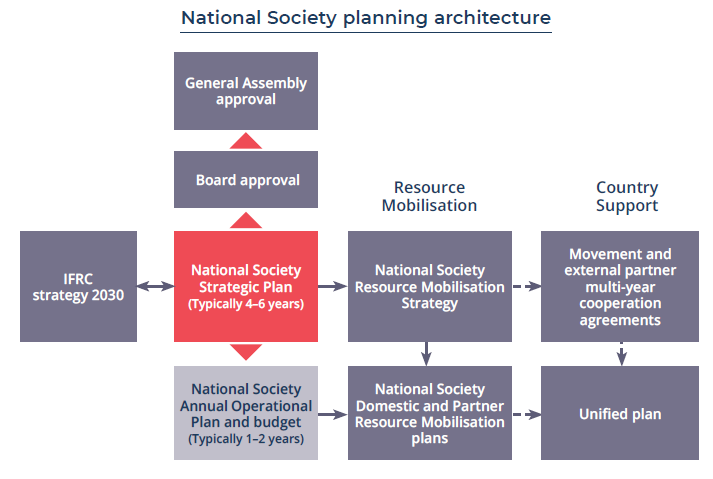
Each National Society has its own planning architecture, but the next step is usually to develop operational plans that turn the strategy into concrete actions. These plans are typically created for each unit and should include:
- Actions to be taken.
- Budgets.
- Indicators for success.
- Critical assumptions (such as support needed from other parts of the organisation).
Core Concepts & Definitions
Strategic plans and operational plans
A strategic plan contains the high level priorities a National Society wants to achieve, in most cases for a time period of 4–6 years. But this does not describe the detail of what a National Society will do each year. For this, most National Societies have annual operational plans and budgets.
A strategic plan will usually contain:
- A high level vision for where the National Society will be at the end of the strategic planning period.
- 3–5 high-level goals the National Society is trying to achieve, for example:
- Contribute to the health and well-being of the population
- Become more financially self-sustaining
- 3–5 priorities that are critical to achieving each high-level goal, for example:
- Reduce malaria deaths in the country by 2%
- Increase locally generated income by 20%
Priorities should be described in a way that makes it possible to collect data to measure whether they have been achieved.
Main activities
Any important activities that can already be identified as critical to achieving the priorities, especially activities that the National Society has not carried out before, or involve changing ways of working.
While it’s tempting to include every activity the National Society will carry out, too much detail can make the strategic plan heavy and difficult to read. This level of detail is better contained in the operational plan.
An operational plan takes the priorities of the strategic plan and turns these into activities, indicators and budget, usually for a twelve month period.
Activities & Decisions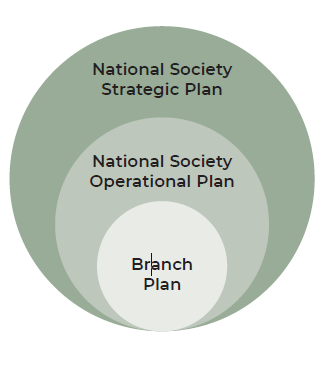
Translating the strategy to branches
Branches play a key role in making the strategy real at the local level. This often means branches develop their own annual operational plans, aligned with the national strategy.
Examples & Learning
Argentine Red Cross
“After years of experience with annual operational planning and monitoring at the headquarters level, and growing involvement from branches in strategic planning, we decided to support branches in developing their own local operational plans with budgets. We created a simple model that each branch could use.”
— National Coordinator of Management and Planning, Argentine Red Cross