Purpose & Strategic Importance
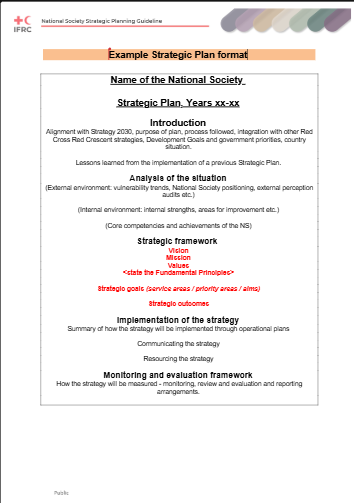
Strategic plans vary widely. Some are short and high-level, others are detailed documents with extensive analysis. The most important factor is that the final product serves the needs of the National Society — both as a decision-making tool internally and as a communication tool externally.
Activities & Decisions
Key considerations
- Level of detail – Decide whether the plan should set broad directions (with details left for annual operational plans) or include specific commitments.
- Purpose of the plan – Is it mainly for internal alignment, for partner engagement, or both? This will affect the format and level of detail.
- Communication value – The plan should be visually clear and accessible. It must inspire staff, volunteers, and partners to align behind it.
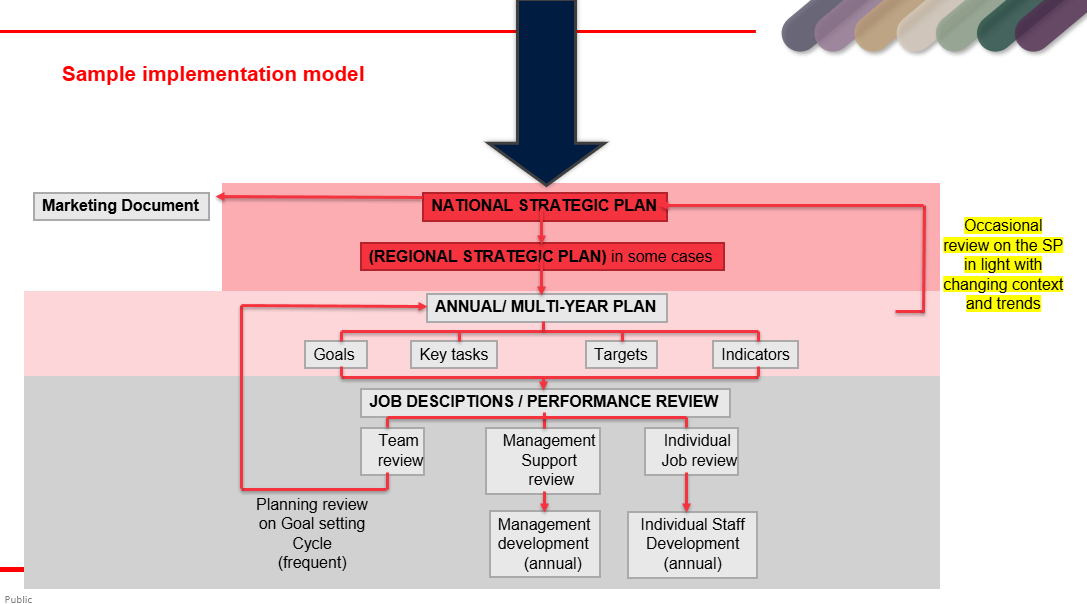
- Flexibility – Keep strategic priorities at a high level, leaving space to adapt through operational plans and annual reviews.
- Writing and review – Agree early who will draft the plan (coordination team, internal writing group, or consultant under supervision) and how it will be reviewed and validated.
Implementation Notes
Good practice
- Use operational plans and budgets for detail, so the strategy remains relevant over its 4–6 year timeframe.
- Involve governance in reviewing drafts to ensure the text reflects decisions taken.
- Anticipate how the plan will be presented: full document, summary versions, or communication materials for volunteers and partners.
How to write the final strategic plan?
A challenge reported by several National Societies was in writing and finalising the strategic plan. This is a key phase that presents the risks of not aligning the text with the results of the conversation and the decisions agreed by National Society leadership.
Additionally, it may be a heavy phase for National Societies with limited capacities which may delay the process.
Different aspects should be considered to ensure alignment and finalization of the plan:
- Who will write it? E.g. setting up an internal writing team or contracting a consultant
- Who will oversee it? E.g. identifying a senior manager to oversee the process
- How will it be reviewed
Artificial Intelligence (AI) may also be a useful tool in this phase.
Examples and Learning
Salvadoran Red Cross
“In 2012, we developed our first strategic plan only to respond to a donor requirement. In 2014, we had to put it on hold and write an intermediary plan more adapted to our context and needs, giving us time to conduct a proper process towards a new plan in 2016.”
📎 See also: Deciding Transparently and Integrating with Other Processes