Value Proposition
Design a strategic planning process that fits the National Society’s context, resources, and ambitions, enabling clear choices, shared ownership, and realistic priorities.
Purpose & Strategic Importance
Every National Society is different, and so is every strategic planning process. Designing the process well helps ensure that strategic planning supports decision-making, reflects reality, builds ownership, and leads to a strategy that can be implemented and adapted over time.
Principles
- Context-specific design: There is no one-size-fits-all process; the design should reflect context, capacity, and purpose.
- Leadership ownership: The process must be led from within the National Society.
- Participation and dialogue: Inclusive engagement builds understanding, ownership, and commitment.
- Realism and focus: The process must support clear choices aligned with available resources.
Inputs
- Understanding of the current situation: Information on services, partnerships, internal capacity, and experience since the previous strategy.
- Clarity on context and future challenges: Insights on emerging humanitarian needs, risks, and opportunities.
- Leadership mandate: Clear direction from governance and senior management on scope, timeline, and purpose.
- Available resources: Indicative time, staff capacity, and budget for the process.
Activities & Decisions
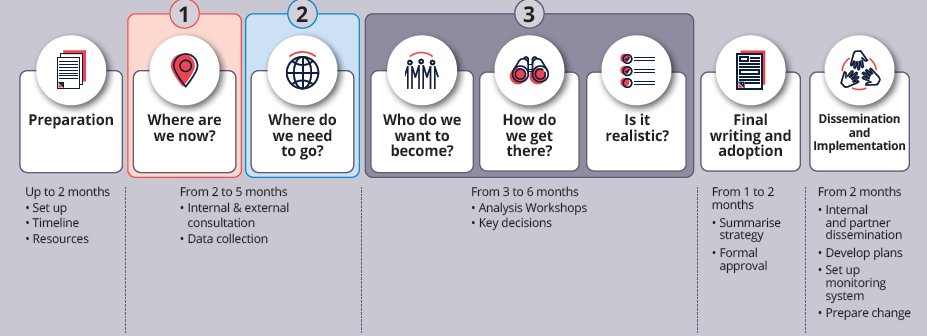
A good process answers three big questions:
- Where are we now?
- Where do we want to go?
- How do we get there? From data to decisions
Use analysis to turn evidence into clear, focused priorities that reflect your ambition — and your reality.
Start by:
- Activity – Defining leadership and ownership: Ownership matters. A strong process is led from within. National Society leaders set the tone and define: Who will be involved, The timeline and scope, How the plan connects to decision-making and budgeting
- To execute the day-to-day work and coordination, often a Coordination Team is set up and oversighted by a dedicated committee (or by the whole) Governing Board.
- Learn more details from here: "Owning and leading the process", "Coordinating through a dedicated team", "Overseeing with governance structures", "Clarifying decision points"
- Decision – Choosing the type of strategy: Decide whether the strategy focuses on transition, consolidation, managed downsizing, or expansion. Your strategy can focus on change, stability, or growth. Choosing the right type helps shape the tone and content of your planning process.
- Transition strategy — guiding major internal change (e.g., restructuring, shifting focus)
- Consolidation strategy — strengthening what’s already working
- Managed downsizing — reducing commitments in a planned way
- Expansion strategy — growing your reach or services, with new partnerships or funding
Decision – Should we involve external support: External support and advisors can help — but the plan must be yours. Avoid giving away ownership, the external supporter (such as consultants) should not be writing your strategy alone or decide your priorities. External support engagement is seen effective when engaged to:
- Facilitate workshops
- Share peer experiences
- Offer technical advice in the process
Learn more details from here: "Mobilising external support carefully"
- "The consultant didn’t know our context — we had to redo everything.” — Central African Red Cross
- Activity – Designing the strategic planning process: Structure the process around three core questions: Where are we now? Where do we want to go? How do we get there? There’s no one-size-fits-all for the process and the final product. Let your environment guide the design.
- Visit here for some further details "Shaping a fit-for-purpose process", "Adapting to context and needs"
- Activity – Plan and Budget for the strategic planning process: Plan ahead so you don’t stall halfway.
- Key reflection points could be found from here: "Timing and budgeting realistically"
- Activity – Understanding where we are now: Review current performance, services, partnerships, and organisational capacity to identify what is working and what needs to change.
- Activity – Exploring where we want to go: Reflect on future challenges, opportunities, and the kind of National Society the organisation wants to become.
- Activity – From data to decisions: Use analysis to turn evidence into clear and focused strategic priorities that reflect both ambition and reality.
- Decision – Defining the final product. What should the final product look like?: Match the plan format to your goals. Some strategies are short and visual — great for engagement. Others are detailed and directive — good for internal coordination. Determine what is the use of. General tips:
- Keep priorities high-level
- Leave room to adapt
- Use operational plans for detail
- Read details from here: "Envisioning the final product | National Society Capabilities"
- Activity – Integrating with other processes: Plan how the strategy will link to operational planning, budgeting, implementation, monitoring, and partnerships. Your strategy should guide — not sit on a shelf.
- How will this guide our operational planning and budgeting?
- How will branches be involved in implementation?
- How will we track progress?
How will it influence our partner relationships?
Think about alignment from the start to avoid a disconnect later. Learn more from here: "Integrating with other processes"
“Linking strategy to operational planning was a game changer.”
Common Challenges and Risks
Loss of ownership through external support overtaking the role NS leadership and coordination team should have led
Mitigation: Keep leadership and decision-making within the National Society.
Unrealistic timelines or budgets
Mitigation: Plan conservatively and reflect capacity from the start.
Disconnect from implementation
Mitigation: Integrate operational planning and budgeting early.
Implementation Notes
- Design the process before starting consultations.
- Make decision points explicit and transparent.
- Think about implementation and adaptation from the beginning.