Purpose & Strategic Importance
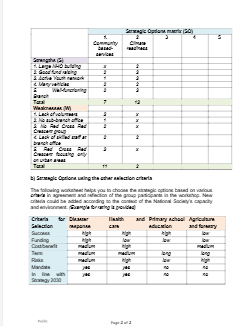
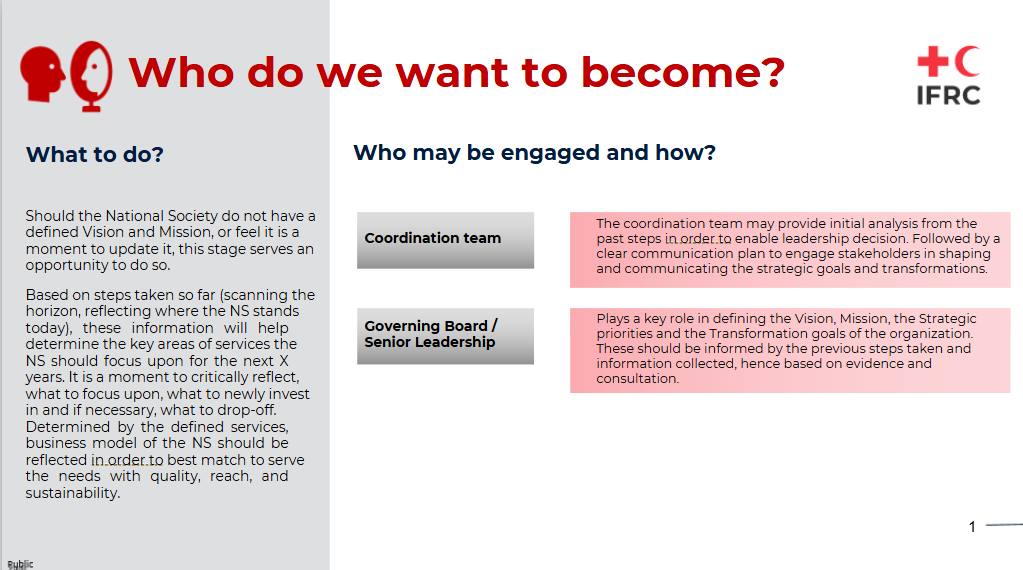
As data are collected and analysed, some priorities become very clear — for example, strengthening the auxiliary role or investing in local resource mobilisation. Others are more difficult and require deeper discussion.
It is the responsibility of National Society leadership to define realistic priorities for the future. If difficult choices are avoided, the strategic plan risks becoming irrelevant or failing to address serious risks.
Activities & Decisions
The role of leadership and governance
- Leadership must define ambitious but realistic priorities.
- The Governing Board oversight committee is recommended to propose the main outline of the strategic plan.
- These proposals should be discussed and agreed by the Governing Board before the final draft goes to the General Assembly or other decision-making body.
- If the plan involves a major shift in direction, it is useful to discuss this early with the Board to confirm support.
Balancing operational and organisational priorities
Strategic choices must balance:
- Operational priorities that allow the National Society to meet its mandate.
- Organisational development priorities needed to sustain those operations over time.
Examples & Learning
Syrian Arab Red Crescent
“One of the objectives of our 2020–2022 strategy was for the national headquarters to step back from implementation, and for branches to develop the capacity to take the lead.”
— NSD and Strategic Planning Unit Manager, Syrian Arab Red Crescent
Implementation Notes
Closing activities
The decision to close a service is always challenging. People benefiting from the service, staff, and volunteers may all want it to continue, and closures can attract negative publicity. Yet National Societies must ask:
- Is this service in line with our mission and values?
- Are we the best placed actor to deliver this service, or could another organisation take over?
- What is the impact on communities if we do not provide this service?
- Could we achieve greater humanitarian impact by reallocating resources?
- Does this service have synergies with other services we provide?
Foresight tools may help review the overall portfolio of services, identifying which remain most relevant for the future.
Iceland Red Cross
“When I took over the branch, we had several projects. Soon after I started, my board made the decision to review the projects run by the branch. We asked: Did the project fit with the RC strategy? Was another organisation already running it? Were we addressing a unique need? After this review, we made some hard choices, closing and handing over projects we had been running for a long time. We handed over two big projects — one to the city of Reykjavík and another to an NGO — and closed down many small projects to make room for new ones.”
— Branch leader, Iceland Red Cross
Strategic Considerations
Strategic planning and financial sustainability
Many strategic plans include a focus on financial sustainability. A credible plan must reflect the Society’s current business model and how it may need to evolve.
Key questions to address:
- How well does the current business model finance the mandate?
- What are the risks to long-term stability and capacity?
- Are financial management and transparency strong enough?
- What are the opportunities to strengthen income?
- Can the plan be realistically resourced?
Core Concepts & Definitions
Defining a vision for the strategic plan
Strategic planning builds on National Society’s mandate and mission, and can also be a moment to revisit or update them — especially if a statutes revision is underway.
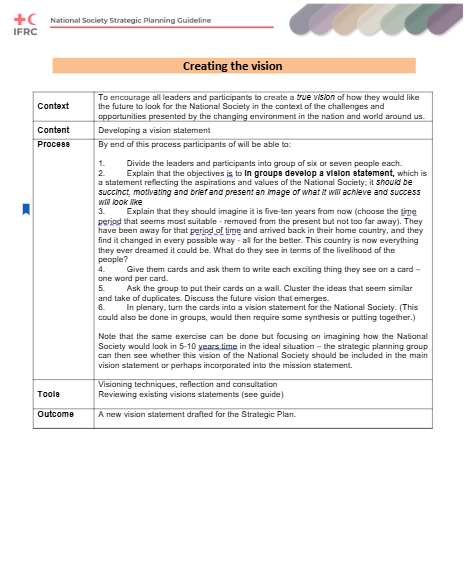
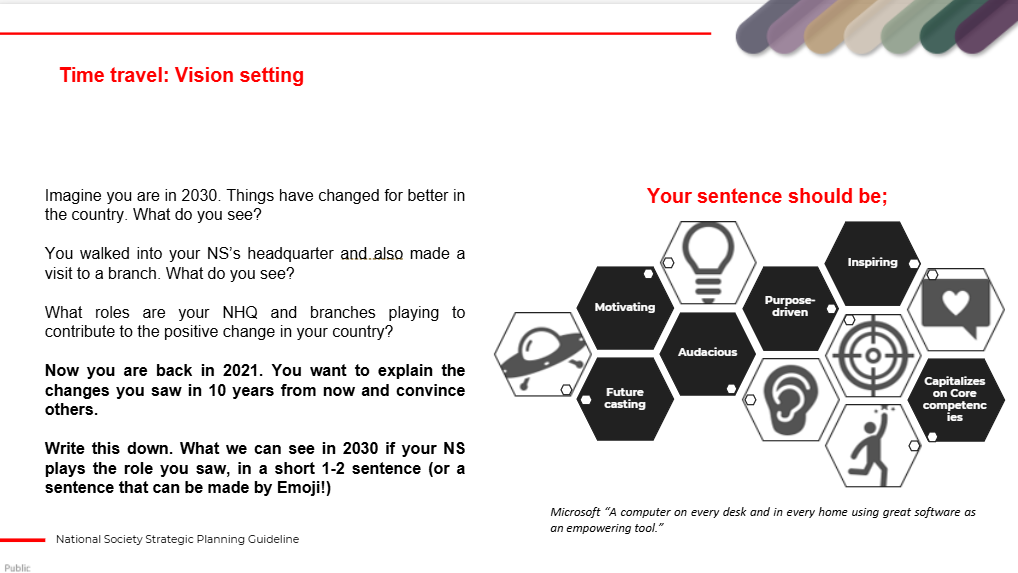
A vision describes where the National Society wants to be by the end of the strategic plan period. It reflects the difference the National Society hopes to make for communities and is shaped by future trends and expected changes.
The vision for a strategic plan should be aspirational but realistic — bold enough to inspire, yet grounded enough to guide action.
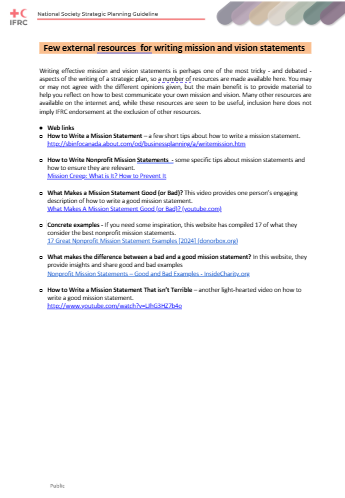
A clear and simple slogan can help make the vision memorable and communicate it easily across the National Society and to partners. If the mission or vision isn’t already defined, the strategic planning process is a good time to create them.