Value Proposition
Volunteers are the beating heart of every National Society (NS). Their experience—how they are treated, supported, and valued—directly defines the strength and sustainability of the Red Cross Red Crescent Movement. Optimizing this experience is about creating a culture where volunteers feel safe, heard, and inspired to continue serving. When volunteers feel valued, respected, and supported, they stay longer, give more, and significantly strengthen the humanitarian fabric of their communities.
Purpose & Strategic Importance
The ultimate aim of optimizing volunteer experience is to sustain volunteer motivation and engagement over time. Fully motivated, engaged, and energetic volunteers are the most likely to achieve maximum impact, making retention a core strategic commitment.
- Sustained Capacity: High retention reduces the constant need for recruitment and training, ensuring a stable, experienced workforce for both long-term programmes and emergencies.
- Trust and Culture: It is built on trust and care, reinforcing the meaning of the Movement's Fundamental Principles (especially Voluntary Service and Humanity) in daily practice.
- Adaptation: It involves supporting the changing landscape of service, including engaging and safely supporting self-organizing volunteers and community-led initiatives, thereby expanding the reach of the Movement.
Scope
This capability encompasses all activities and institutional mechanisms designed to support, engage, value, and listen to volunteers throughout their service lifecycle, from deployment through to exit. It focuses on the quality of the volunteer's journey and is built on daily relationships, inclusion, and respect.
Key Elements Covered:
- Recognition and Celebration: Formal and informal acknowledgement of contributions.
- Wellbeing and Protection: Ensuring the safety and psychosocial support of volunteers.
- Development: Offering learning, leadership, and personal growth opportunities.
- Listening and Feedback: Creating dialogue through tools like Motiro and through everyday dialogue to act on what volunteers share.
- Exit Management: Conducting respectful exit interviews and managing the off-boarding process.
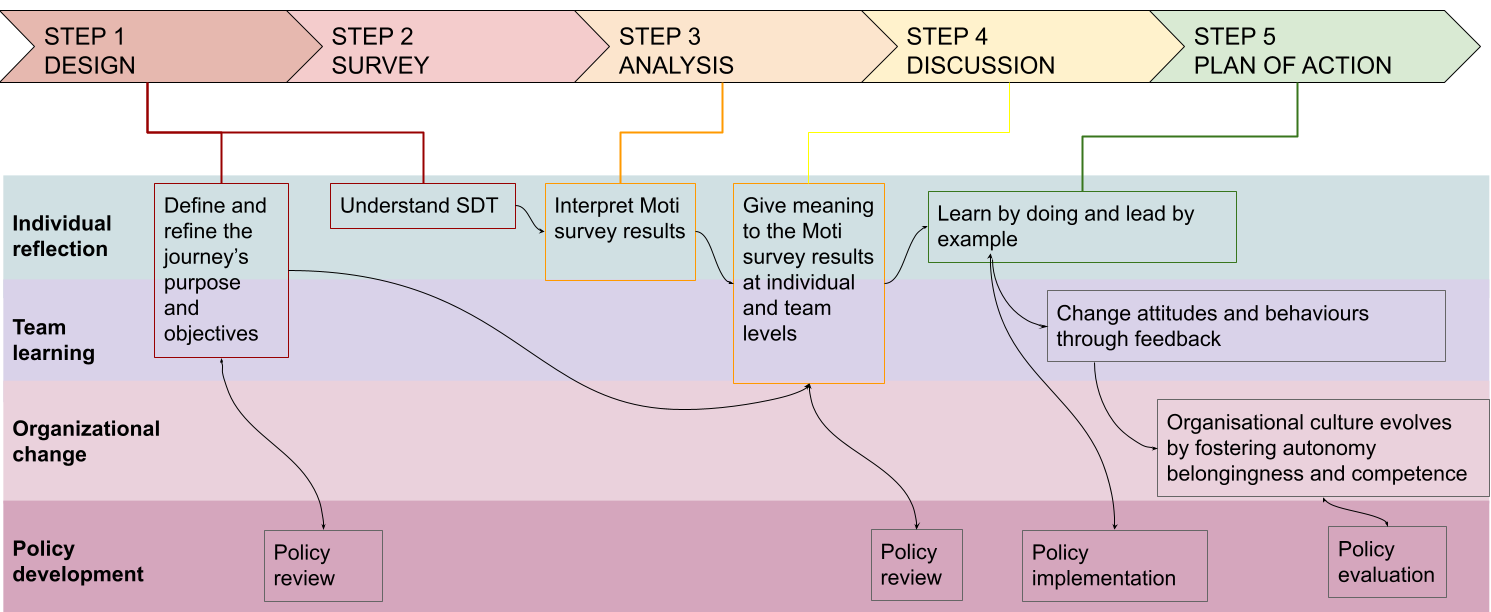
The IFRC’s Motiro approach, designed specifically for Red Cross Red Crescent volunteers, is a science-based, five-step continuous learning process built on Self-Determination Theory (SDT) to enhance motivation and leadership.
Process & Key Activities (Continuous Improvement Cycle)
Optimizing the volunteer experience is a continuous process of learning and transformation.
- Listen & Diagnose: Conduct volunteer surveys (e.g., using Motiro) and everyday dialogue to assess motivational levels and identify areas of need (autonomy, belonging, competence).
- Develop Leaders: Use the data to improve leadership skills—such as listening, understanding, and encouraging—that directly affect volunteer motivation.
- Recognize & Support: Implement systematic, sincere, and regular programs for recognition and ensure access to psychosocial support resources (e.g., the Caring for Volunteers Toolkit).
- Action & Adapt: Act on feedback gathered, ensuring that improvements (e.g., better equipment, clearer roles) are implemented at the branch and national levels.
- Monitor & Evaluate: Track key metrics like Retention Rate and Satisfaction and use these to continuously refine policies and leadership practices.
Results
The optimization process leads directly to a more resilient and sustained humanitarian workforce.
- Outputs (Deliverables):
- Volunteer satisfaction reports and action plans (e.g., Motiro team reports).
- Formal recognition events and awards.
- Psychosocial support resources and programs available to all volunteers.
- Outcomes (Short- to Mid-term Effects):
- Increased volunteer engagement and higher levels of intrinsic motivation.
- Improved Retention Rate (%) and Average Service Length.
- Enhanced psychological safety, mental wellbeing, and inclusion among volunteer teams.
- Impact (Long-term Strategic Change):
- Sustainable humanitarian fabric within the community.
- Stronger leadership and a culture where volunteers thrive and are proud to belong.
- Fully motivated and energetic volunteers achieving greater programme impact.
Enabling Resources
The capability relies on data-driven approaches and supportive governance.
- People & Roles: The Volunteer Manager provides overall stewardship, bridging strategy and practice to champion volunteer safety, recognition, and purpose. HR Officers also play a supporting role in policy alignment.
- Governance: Volunteer policies must be consistently implemented, with explicit commitments to safeguarding, data protection, and volunteer well-being.
- Data & Tools: The Motiro integrated data system (an app based on SDT) is used to survey and monitor motivational levels, leadership impact, psychological safety, and inclusion. This data is critical for evidence-based decision-making.
- Resources: Tools like the Caring for Volunteers – A Psychosocial Support Toolkit provide essential resources for supporting volunteers before, during, and after a crisis.
Examples & Innovative Practices
The innovative use of motivation science is a key practice.
- Motiro App: Used by dozens of Red Cross Red Crescent entities to collect motivation data from thousands of volunteers, automatically generating data-based narratives for teams to identify and address motivational barriers.
- Leadership Development: Motiro links survey results to the Full Range Leadership Model, showing team leaders how improving skills like listening and encouraging can satisfy volunteers' basic psychological needs (autonomy, belonging, competence).
- Psychosocial Support: Implementing comprehensive toolkits and resources to provide care for volunteers, especially those involved in emergencies, demonstrating an active duty of care.
Common Challenges
Maintaining high engagement requires continuous effort against predictable hurdles.
- Recognition Gaps: Inconsistent or insincere recognition efforts, leading to volunteers feeling undervalued.
- Burnout: Lack of adequate support or poor assignment management leading to volunteer fatigue and drop-out.
- Feedback Action: Listening to volunteers (via surveys or dialogue) but failing to act on their feedback, which breaks trust and increases disengagement.
- Inclusion Barriers: Failing to create a truly inclusive environment where all volunteers feel safe and heard, particularly concerning gender or cultural differences.
- Leadership Deficit: Team leaders lacking the necessary skills to motivate, support, and manage volunteers effectively.
-------------------------------------------------
Motiro
The ultimate aim of volunteer experience optimization is to sustain volunteer motivation and engagement over time.
Fully motivated, engaged and energetic volunteers are the most likely to achieve impact. Poorly motivated volunteers (i.e. teams with low motivation scores) are a predictor of low or even negative impact.
Motivating volunteers is best done using the science of psychology. The most widely tested and tried framework on human motivation is Self-determination theory (SDT). The IFRC's Motiro approach was designed on SDT specifically for Red Cross Red Crescent volunteers. It is a five step process that takes the point of view of the volunteer, i.e. how it feels to be a volunteer for a National Society, a branch or a team. Motiro is a process of continuous learning, transformation and leadership development.