Purpose & Strategic Importance
Branches play a critical role in making a strategic plan work. While National Societies differ in how much autonomy branches have, it is essential to include their perspectives throughout the planning process. This helps build ownership and ensures the strategy is relevant across the whole organisation.
Activities & Decisions
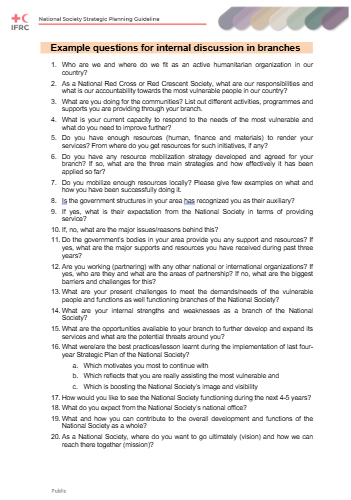
Key questions to consider
- Do branch capacities allow them to carry out the National Society’s mandate?
- Does the current internal regulation create a good balance between branch autonomy to meet localised needs and the need for coherence across the organisation?
- Are there lessons from high-performing or innovative branches that could inform the Strategic Plan?
Ways to involve branches
- Surveys to gather input from many branches efficiently.
- Focus groups to explore key themes with branch leaders and staff.
- Internal meetings where strategic planning can be added to the agenda of existing discussions.
Examples & Learning
Eswatini Red Cross
“A team from HQ visited all branches to sit with staff and volunteers and discuss plans and vision. Branches had the chance to contribute and were later invited to review the draft strategy.”
— Branch Coordinator, Eswatini Red Cross
Malawi Red Cross Society
“Our branches help develop the five year strategic plan and then create their own annual plans. Normally we asked them what it is that they would like the NS to address, and how. We learnt that branches can do well and contribute positively if empowered and supported. With the right support, they’ve shown they can lead and shape the National Society’s direction.”
— NSD Practitioner, Malawi Red Cross Society
Iraqi Red Crescent Society
“We visited branches, collected data with new tools, and created action plan templates. We have learned a lot due to a very wide experience the branches have in the field, though follow-up and monitoring remain a challenge. The data collection tools and templates were very impactful.”
— Senior Manager, Iraqi Red Crescent Society