Purpose & Strategic Importance
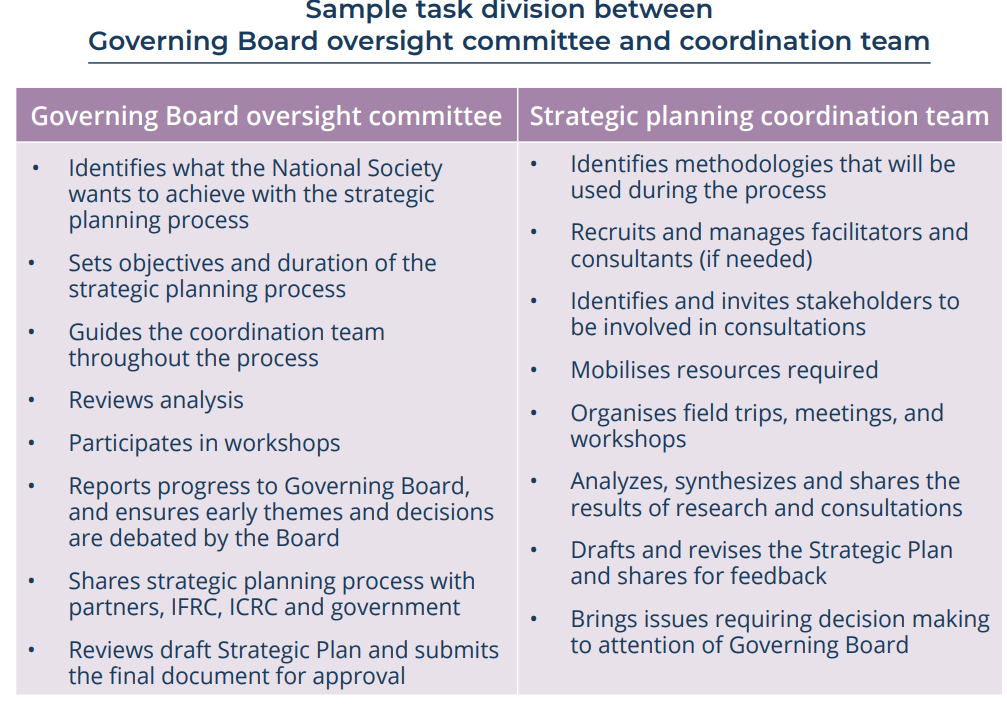
Every strategic planning process requires day-to-day leadership. This is the role of a Coordination Team — a group responsible for managing activities, collating data, and preparing briefings and drafts for decision-makers.
Activities & Decisions
What is the role of the Coordination Team
- Organising the process – plan activities, monitor progress, and ensure deadlines are respected.
- Collecting and analysing inputs – gather data from consultations and existing sources, then summarise results for use in discussions.
- Preparing decisions – structure proposals and recommendations for senior management and the Governing Board.
- Drafting outputs – compile materials, including draft versions of the strategy, for review and approval.
- Communicating – brief leadership, coordinate feedback, and plan communication of the draft and final plan.
Enabling Resources – People
Team composition
The size and scope of the team will vary depending on the National Society’s context, but a minimum team would usually include:
- Senior Manager – provides overall accountability and dedicates part of their time to liaising with governance. Ideally dedicating 20% of their time.
- Lead Manager / Coordinator – dedicates most of their time to the process, drives activities, and supports drafting. Ideally dedicating 80% of their time to the process
- Branch Leader – ensures branch perspectives are represented and channels input from other branches.
- Support Staff – provide administrative and technical support where available.
Additional arrangements
- In larger National Societies, the team may be led by a Deputy Secretary General or Under-Secretary General.
- The team should be inclusive and diverse, ensuring perspectives from across the Society.
- Working groups can be set up for specific issues (e.g. financial sustainability, youth engagement), with clear terms of reference and reporting lines.
Examples & Learning
Argentina Red Cross
It was important to involve branch leaders not only to capture their diverse views, but also to facilitate consultations and data collection. We created working groups where they played an active role. The commitment and presence of National Society leadership was key — it showed the importance of the process and helped ensure broad participation. – National Coordinator of Management and Planning, Argentine Red Cross
📎 See also: Owning and Leading the Process and Overseeing with Governance Structures.