
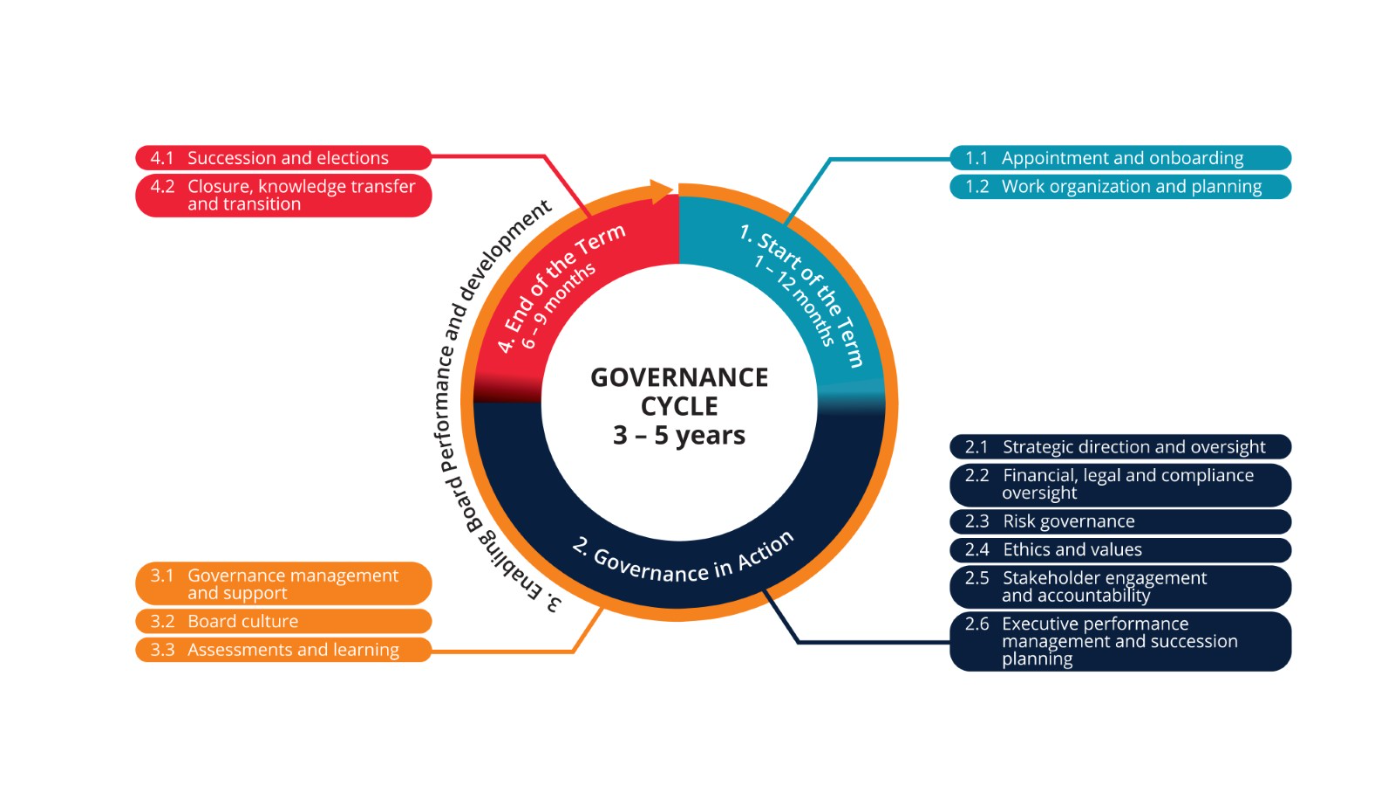
Board cycle
Board work follows a cycle—Start of Term, Governance in Action, and End of Term—anchored in the mandate from the general assembly and supported by structured onboarding, a focused governance work plan, regular reflection and performance assessments, and planned succession and handover. Each phase brings together specific duties, expected outcomes, and practical tools, helping the board to stay proactive, strategic, and learning oriented rather than merely reactive to issues as they arise.
Value Proposition
Good governance enables National Societies to act with integrity and accountability by setting clear direction, ensuring transparent and ethical decisions, and maintaining trust with members, partners, and communities. It upholds the Fundamental Principles and legal frameworks, protects independence, clarifies roles between governance and management, ensures leadership continuity, and strengthens risk management.
Purpose & Strategic Importance
Developing governance capabilities turns governance principles into action. It enables boards and management to work together effectively—making informed decisions, steering strategy, and safeguarding trust. Leaders learn to apply roles and processes, exercise authority responsibly, and fulfill the Society’s auxiliary role. Strong governance capability drives accountability, continuity, and organizational development, ensuring governance delivers real impact—not just words on paper.
Core Governance Concepts & Definitions
- Governance – Sets direction, provides oversight, and ensures accountability in line with statutes and the Fundamental Principles.
- Management – Runs day-to-day operations and implements board decisions within delegated authority.
- Checks and balances – Uses rules, mandates, and controls to prevent misuse or concentration of power.
- Fiduciary duties – Require board members to act in good faith, with loyalty and care, in the National Society’s best interests.
Principles
- Integrity – Means acting consistently with values, rules, and humanitarian principles.
- Integrity – Acting consistently with values, rules, and humanitarian principles.
- Independence – Making decisions free from undue influence while remaining true to the Movement’s humanitarian mandate.
- Legitimacy – Authority to govern grounded in statutes, a recognized Movement role, member accountability, and fidelity to the Fundamental Principles.
- Accountability – Being answerable for decisions, performance, and the use of resources.
- Transparency – Making decisions, roles, and processes open and clear.
- Stewardship – Protecting resources, reputation, and the mandate for the long term.
- Compliance – Acting within national law, statutes, internal rules, and Movement requirements.
Links with Related Capabilities
Governance in National Societies serves as the strategic backbone that enables and strengthens other core capabilities such as:
1. Leadership Cultivation and Cultural Alignment
- The board monitors management performance fosters leadership development via succession planning and training, and shapes a leadership culture rooted in the Fundamental Principles and ethical decision-making.
2. Integrity and Risk capability
- The board embeds integrity through checks, balances, and fiduciary duties, while mandating systematic risk oversight as a core board responsibility. It ensures risks to reputation, operations, and principles are identified, assessed, and mitigated proactively.
3. Resource Mobilization
- The board approves fundraising strategies, sets ethical mobilization policies, and builds donor confidence through transparency and accountability. Strong governance creates the trust environment needed for sustainable partner and public support.
4. Asset Management
- The board enforces stewardship duties over physical assets, infrastructure, and long-term investments through policy approval and oversight. Boards ensure assets serve the humanitarian mandate efficiently while maintaining their value and utility.
5. Financial Management
- The board establishes financial controls, approves budgets, and monitors fiscal sustainability through fiduciary oversight and audit requirements. It prevents misuse while ensuring resources align with strategic priorities and statutory obligations.
6. Legal Base and Auxiliary Role
- The board upholds statutory compliance, Movement recognition, and the auxiliary relationship with public authorities. It protects legal standing, autonomy, and fidelity to Fundamental Principles, enabling mandated humanitarian functions.