
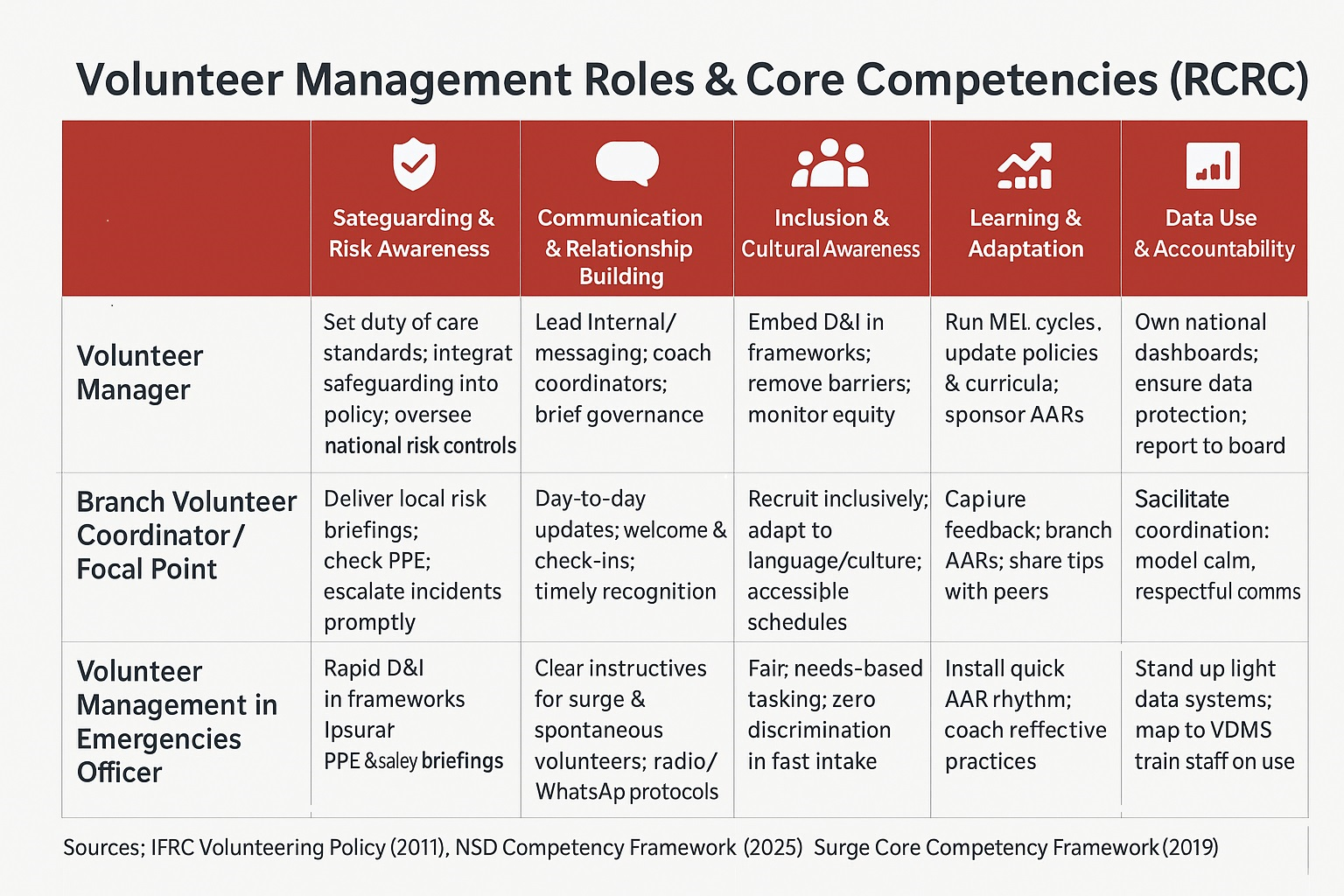
Volunteer management is not just about processes—it’s about people. Different roles carry different responsibilities, and each requires a set of core competencies to be performed well. By defining these roles clearly and supporting them with the right skills, National Societies can ensure that volunteers are safe, motivated, and well-led. The framework below maps out the key roles involved in volunteer management and the competencies they must master. It draws on the IFRC Volunteering Policy, the NSD Competency Framework, and the Surge Core Competency Framework, as well as lessons from National Societies.
IFRC Volunteering Policy (2011)
NSD Competency Framework (2025)
Core Competency Framework for Surge Personnel (2019)
Competency Development Guide (Surge Learning)
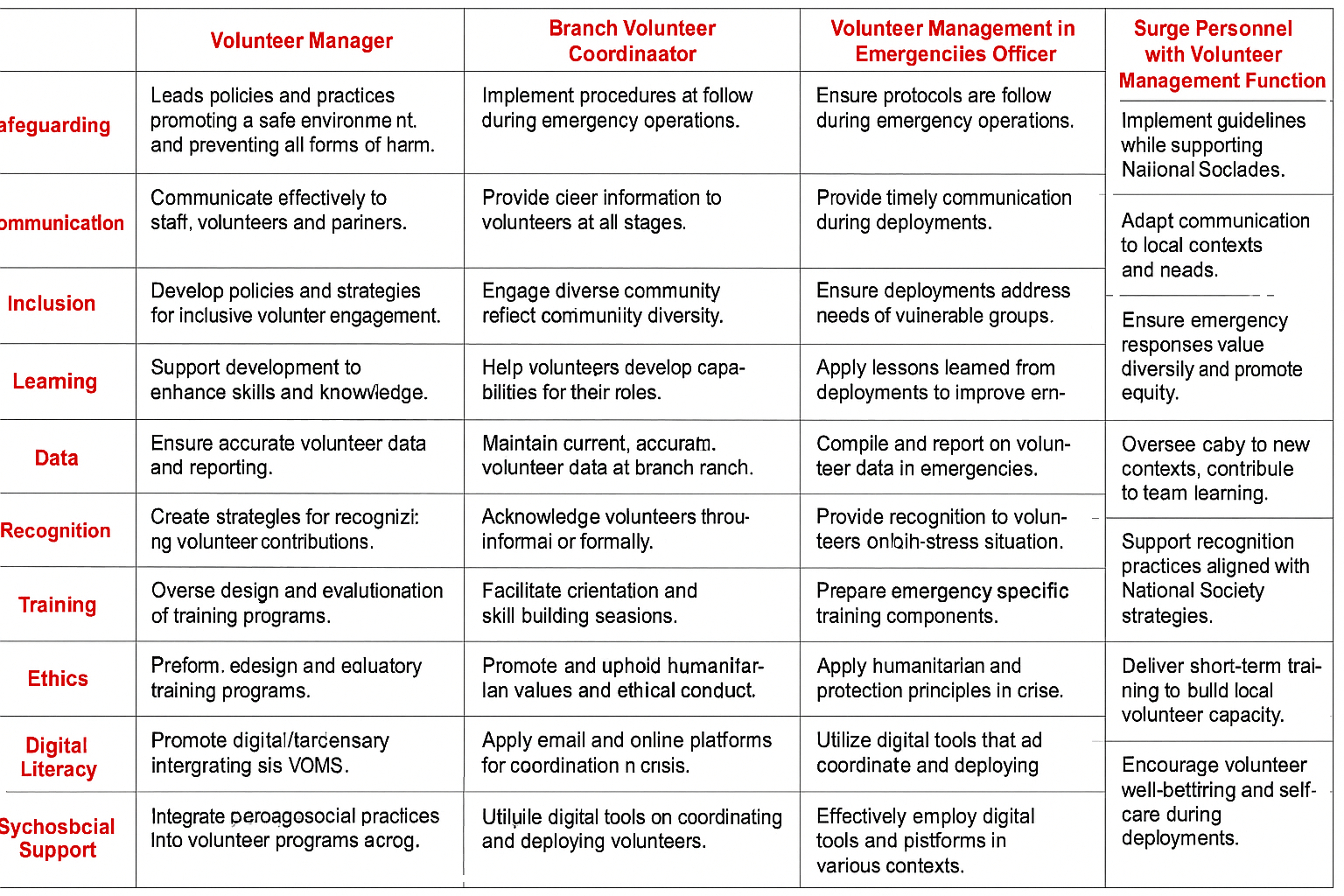
Role–Competency Matrix
This framework maps the core competencies required across key roles in volunteer management. It shows how each competency is applied differently depending on the role, providing clarity for training and development in National Societies.
Why this matters
- Clarity reduces risk: Everyone knows who is responsible for what, reducing duplication and gaps.
- Competencies drive confidence: Staff and volunteers in leadership roles feel equipped to manage situations fairly and safely.
- Learning is continuous: Competencies are not fixed—they grow through training, mentoring, and reflection, which this framework encourages.
The roles and competencies outlined here are not theoretical—they are grounded in the real practices of National Societies around the world. Every Volunteer Manager, Branch Coordinator, or surge role holder benefits from clear expectations and a roadmap for development. National Societies can adapt this matrix to their context, add local role profiles, and connect competencies to their training systems. By doing so, they create a workforce of leaders who protect, inspire, and sustain volunteerism at every level.
Competencies:
Safeguarding & Risk Awareness
Communication & Relationship Building
Inclusion & Cultural Awareness
Learning & Adaptation
Data Use & Accountability
Volunteer Recognition & Motivation
Training & Capacity Building
Ethical & Legal Awareness
Digital Literacy & Technology Use
Emotional Intelligence & Psychosocial Support (PSS)